
By Keith Alan Robinson

It can be rather uncomfortable to be put on the spot. Especially, when you have something to hide.
Some of the board members of the Upper Little Bear Community Home Owners Association near Blue Jay recently enlisted Cal Fire to mitigate fire hazards on their property and some of their own residents do not like the results – or, the way it was forced upon them.
Additionally, claims about misuse of authority and “the sneaky way it all happened” have made many residents feel steamrolled.
A meeting was scheduled for Sunday November 21st and forestry expert, Dr. Chad Hanson was called in to offer an alternative viewpoint to how the forest should be dealt with. The meeting did not start well.
“Why are you here?”
“This is a private meeting.”
“No one invited you.”
“You are on private property, get out of here!”
“Why is the press here?”
This set of questions and demands were not just spoken, but shouted rapid fire and with intensity by two of the board members of the Upper Little Bear Board directed toward the Mountain News and others at the intersection of Golf Course and Old Toll Roads in Lake Arrowhead. This reporter thought he was about to be punched in the face.
Before long, several other press members from San Bernardino showed up and helped to prevent an act of violence, which seemed to be forthcoming. Ed Reichardt, the HOA President, who would not talk to press or even identify himself, stomped around and fumed like a kid who just got caught with his hand in the cookie jar, and now he seemed to be looking for a fight. Over the course of an hour, he repeated the complaint: “Why is the press here?” more than a dozen times.
The small contingent was a bit mollified when it was suggested by another Upper Little Bear resident that the reporters were eager to hear both sides of the story and another resident reminded board member Pete Cores, who had earlier demanded that “everyone leave,” that indeed “everyone” was currently standing on a public road, not private property. Thus, was the atmosphere at a gathering to hear out a forest and wildfire scientist who holds an opinion and scientific evidence that differs with some of the hardened residents or Upper Little Bear community.
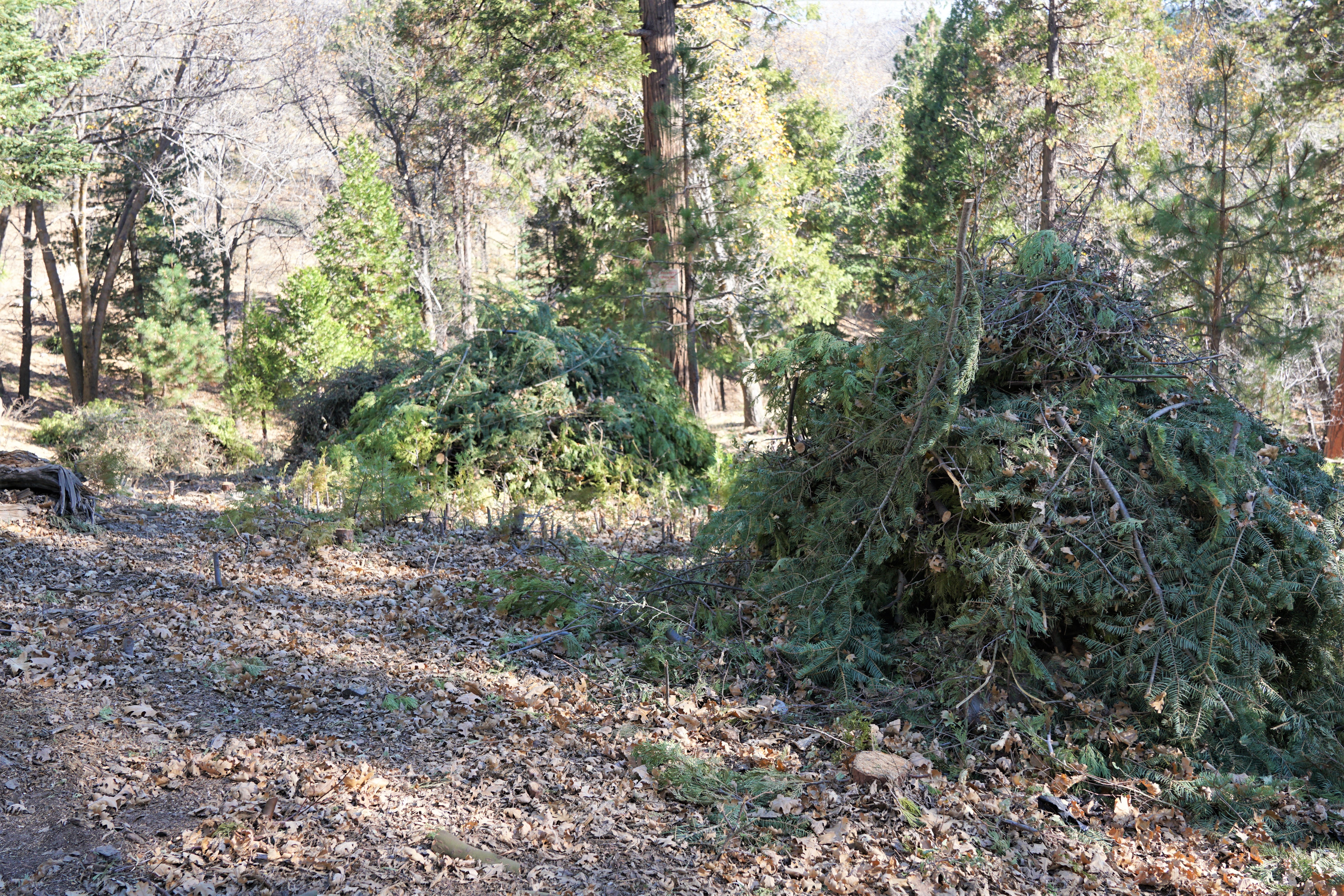
The land in question is about 40 acres and stands between downtown Blue Jay and Old Toll Road. It is own jointly and equally between all of the 36 homeowners. Cal Fire has been busy cutting down and masticating every living thing smaller than 12 inches in diameter and piling it up in large clusters to be burned later.

Dr. Chad Hanson, a fire and forestry field researcher, author, speaker and renowned wildfire expert was present to tell the crowd that what was currently being done by Cal Fire was indeed making things worse. As Dr. Hanson began however, Pete Cores interrupted him by vigorously announcing that “the meeting is being moved to ‘our property’ so the press cannot follow us.” An argument ensued between the board members themselves, and then, President Reichardt said that this meeting was now “under suspicion because the press is here and it was not announced.”
It turns out that the press was called by one of their own – an individual who not only lives in the Upper Little bear community, but a secret person who believes that the clear-cutting of the forest was not approved by the members, nor that it is in the best interest of the community or Lake Arrowhead in general. The secret person is known simply as DT2 because they are afraid of Reichardt and his tendency to bully, intimidate, and retaliate.”
“Reichardt, Cores and Bill Reeves have run this operation like it’s their own personal kingdom,” said DT2. “Nothing has been done with proper authorization from the community. The dealings with Cal Fire have all been done in secret and this forest and wildlife habitat decimation is all being done with taxpayer money.”
Eventually, Dr. Hanson was allowed to continue and he began to describe what his research has taught him about forest clearing and fire behavior. His gentle and matter-of-fact demeanor was a calming influence at a meeting, which continued to be very hostile.
The aforementioned Bill Reeves, who has lived on the property for his entire 81 years, says this brush and tree clearing has been done “three or four times” over his life time. However, this time he says, “someone objected and got some followers, and this is the result.” The result Reeves is referring to is an objection to not only the cutting down of the forest and threatening wildlife habitat, but the fact that he and a couple others in the community are being called to the mat for their unchecked decisions.
Cal Fire was called in to do what has been done in many other places. According to David Haas, the San Bernardino Unit Forester, “we are always looking for fuel reduction opportunities wherever we can find them.” So, when a landowner asks for this work to be done, Cal Fire does not ask many questions. “All this work, what we call forest care, used to be part of a federally funded program,” said Haas. “That funding dried up about 10 years ago.”
These days the work is funded by California State tax money as part of the annual budget under former Governor Jerry Brown’s Executive order #B-052-2018. Governor Brown, in a reaction to the devastating fires of 2017 – 2018, issued this order to create a Forest Management Task Force and pushed the number of acres for fuel mitigation each year from 250,000 to 500,000 acres.
“As unit forester, I, along with all the other foresters in California have an annual total quota of half a million acres to complete fuel reduction and hopefully moderate fire behavior,” continued Haas. “Our goal is forest health and forest care.” The question begs, however, just what is forest care and forest health and why is not a forest’s natural evolution or divine design good enough? “We simply do our best with the tools we have and what we know at the time. “If you ask 10 different foresters that question, you will get 11 different opinions,” he joked. Haas admitted that what they did 30 years ago was different from what they are doing to the forests now and that in another 30 years forest management may use different strategies altogether.
According to Dr. Hanson, those different strategies are already available.
Hanson’s expertise is in the area of forest and fire ecology and how fire behaves in forests. “I am here to talk about what I have learned from science,” he said to the crowd. “What the science tells us is that the only effective ways to protect homes from fire is to make the home itself more fire resistant with what people call home hardening and creating defensible space. I am a strong supporter of defensible space,” he added. “But, the best available science tells us that cutting the forest down as a protection for the home beyond 100 feet does not provide any benefit.”
Paradoxically, even though Haas of Cal Fire supports defensible space, he said that his crews would not work on or around someone’s home, but were more interested in doing work in the forest in general. At press time, Haas said the crews are actually firefighters working to pile up the cut trees and make the forest more manageable in a potential future fire.
“Apparently,” said one resident, “they are cutting down the forest and burning it up now, so that maybe they don’t have to do it later.”
Dr. Hanson explained that home hardening includes “ember-proof vents to prevent hot floating embers from entering inside the house. This can be done for less than a hundred dollars,” he said. “Most homes that perish in wildfires, do so because of this defect.” Hanson gave the example of the Paradise fire, where so many of the trees did not burn, but the homes next to the unburned trees ended up as charred rubble.
“So many things that are emerging from the research are counter intuitive,” Hanson continued. “One of the key assumptions has always been that the more you remove trees and vegetation from the forest, the better you are going to curb fires. However, fires and forest are much more complicated than that. What we have found is that removing vegetation changes the microclimate of the forest.”
According to Haas of Cal Fire thinning the forest of most of the small trees and brush keeps the “fuel load down” and so less fuel means less fire. But, just what is fuel in this scenario? By the time Cal Fire is finished with the Upper Little Bear open space it may look more like an unkempt golf course than a forest. For at least three of the five board members over the area, that suits them just fine.
Hanson’s research and the newest research from fellow scientists have found that trees, shrubs other bushes keep the shade level up and the moister levels higher. It also curbs the growth of invasive grasses. When all the shade is removed, the ground is hotter, grasses get thicker, and wind travels over the ground more easily, thus driving fire toward a house faster and making the area around the homes a fire-ready tinderbox instead.
“When Cal Fire talks about defense lines, what they are really talking about is what they call modified fuel breaks,” said Hanson. “The problem is that the whole fuel break and tree spacing concept has been discredited scientifically. In other words, tree spacing fuel breaks do not work, but defensible space and hardening a home from ember intrusion does work.”
Some people in the mountain communities see the work being done by Cal Fire as a great free service and that thinning the forest out is the best way to go. Others believe that this is just another taxpayer-funded boondoggle.
The problem with defensible space, as many see it, is that those who live in the mountains love the trees right outside their windows and the foliage that shades their property. In addition, many homes are so close to each other that clearing defensible space could eliminate the trees and brush in an entire neighborhood as defensible boundaries would intersect between all the property lines.
As far as Dr. Hanson, is concerned, Cal Fire cannot see the forest for the trees. “Wildfires are not driven by forest density,” he said. They are driven by wind and drought conditions. By clearing the forest, Cal Fire is creating an area which is dryer, prone to wind gusts, and a more dangerous fire.”
Hanson is not a tree hugger as some have claimed. He says he lets the science guide his feelings and beliefs. In addition, he would never put a home ahead of a tree. “The priority in these areas has to be the protection of homes,” he said. “You have to prioritize homes and the safety of the residents.”
After Hanson made his lengthy presentation to the board and homeowners of Upper Little Bear Community, he felt that there was “potential movement in the right direction.” However, the next morning, Cal Fire was on the site cutting down trees. DT2 claims that when a few of the residents asked if there would be a stoppage to the work being done by Cal Fire so more discussion could take place and more research could be done, Bill Reeves flat out said “NO!”
“A couple members of the board and old timers here are ignoring the rest of us in these decisions,” said DT2. “This current bullying of neighbors, the anti-science, anti-democratic, my-way-or-the-highway mentality of these people needs to stop. They only believe what they want to believe. The truth, it seems, just gets in their way.”
For now, it seems that Cal Fire will continue to do what they think is best and be able to chalk up another 40 acres toward their quota, at least until someone stops them.
Some of the people who have stopped forest destruction and will continue trying to stop the cutting down of the forest in the Upper Little Bear community includes: Dr. Chad Hanson as mentioned above, Steve Ferrell of the Sierra Club, Hugh Bialecki of Save our Forests Organization and Edith Martinez of the California Department of Fish and Wildlife.
Steve Ferrell of the Sierra Club pointed out that the wildlife in the 40 acres will suffer a great deal. Not only will the hundreds of trees being removed bring down birds nests and owl habitat, but also it is an area with dozens of protected Southern Rubber Boa Snakes. These snakes will have no where to hide except for the piles of bushes and trees made by the Cal Fire workers, who plan to burn them up, along with any of the snakes hiding inside. “There are ways to manage fire risk without cutting everything down,” said Ferrell. “Planning and zoning changes would do wonders to help.”
Without snakes and owls on the grounds – gophers, and squirrels could proliferate unchecked and continue to damage property and plants around homes.
Edith Martinez of Fish and Wildlife drafted a long letter to Cal Fire warning them to proceed with the project in an altered way to protect the Southern Rubber Boa as they would be required to have a special permit to catch, capture of kill them as per Fish and Game Code Section 86. According to DT2 however, Martinez’ letter was to be sent eight months ago, but was forgotten about and never posted in the US Mail.
Unfortunately, in a phone conversation, Edith Martinez did not want to talk to the press and nervously referred the Mountain News to their “media people” who did not return calls.
So, it seems that a riot of hostility and disagreement is still on the list of possibilities with the Cal Fire project. Distain for the rules of the Upper Little Bear HOA and the residents desire to be heard is a fight still going on. So too, is the fight between Cal Fire and those who believe their actions are antiquated and over done. For now, however, the removal, mastication, and burning up of living things on the property continues.
Mountain residents who want to see for themselves what is being done in the Upper Little Bear open space can get a good look on a walk either direction on Old Toll Road where it intersects with Golf Course Road. Be advised: do not walk down into the property, even where there are trails, as the current climate of distrust and hostility by some residents may bring an onlooker some trouble.
 Left Coast Footprints