Yellowstone National Park on the Edge of Winter

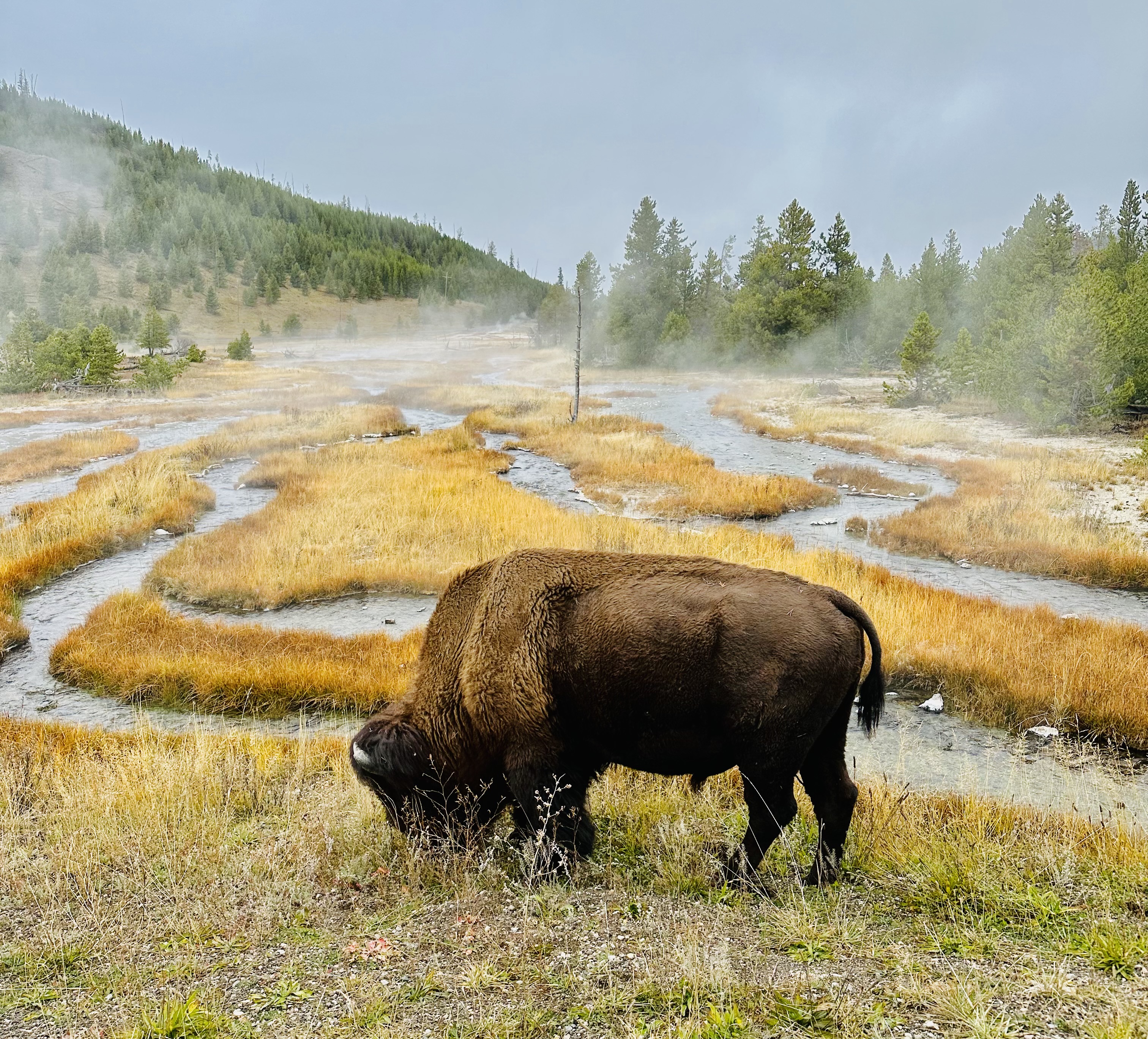
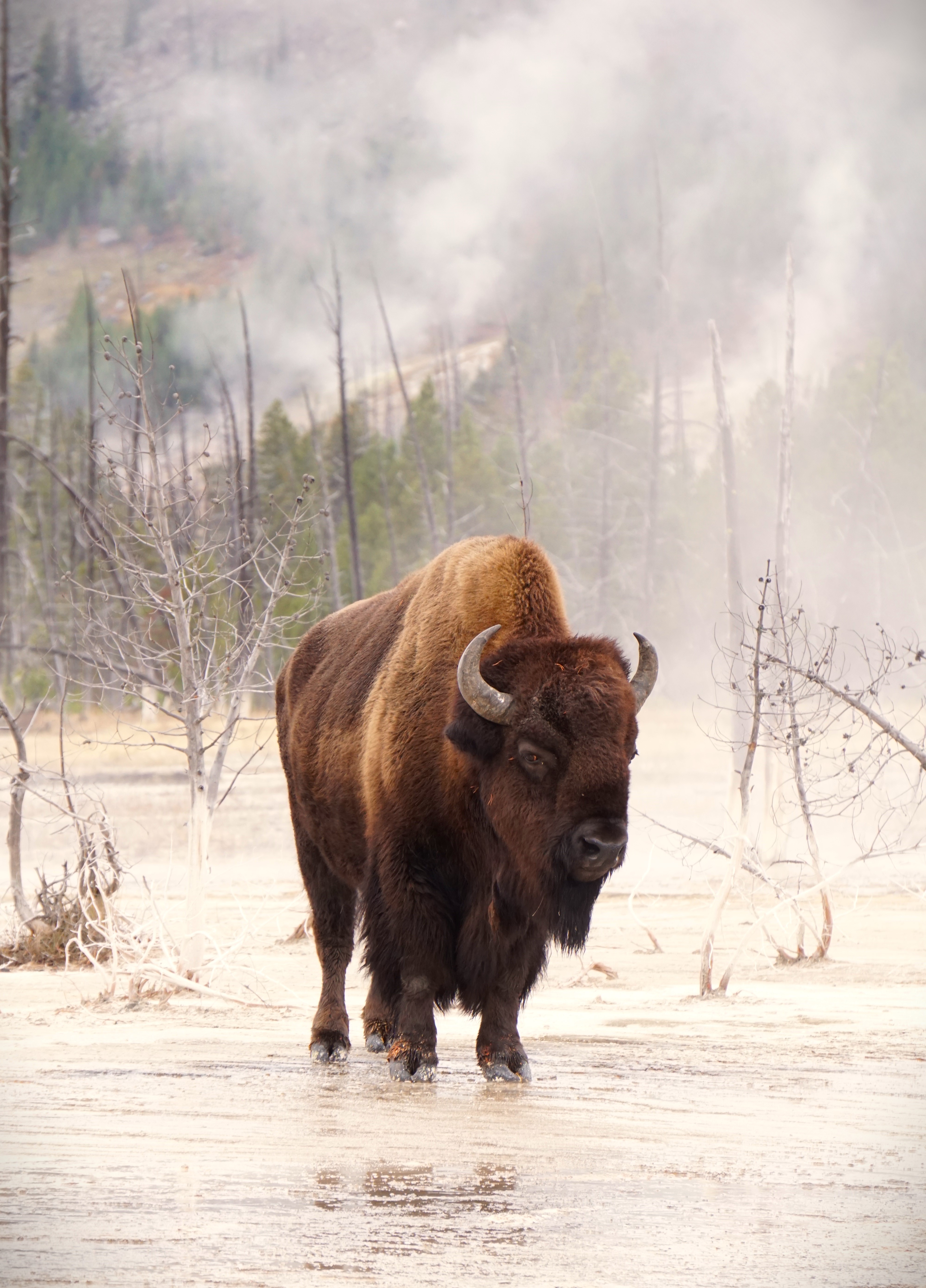
As winter sets in, we spot a Bison in Yellowstone National Park storming around the warm water and geysers.
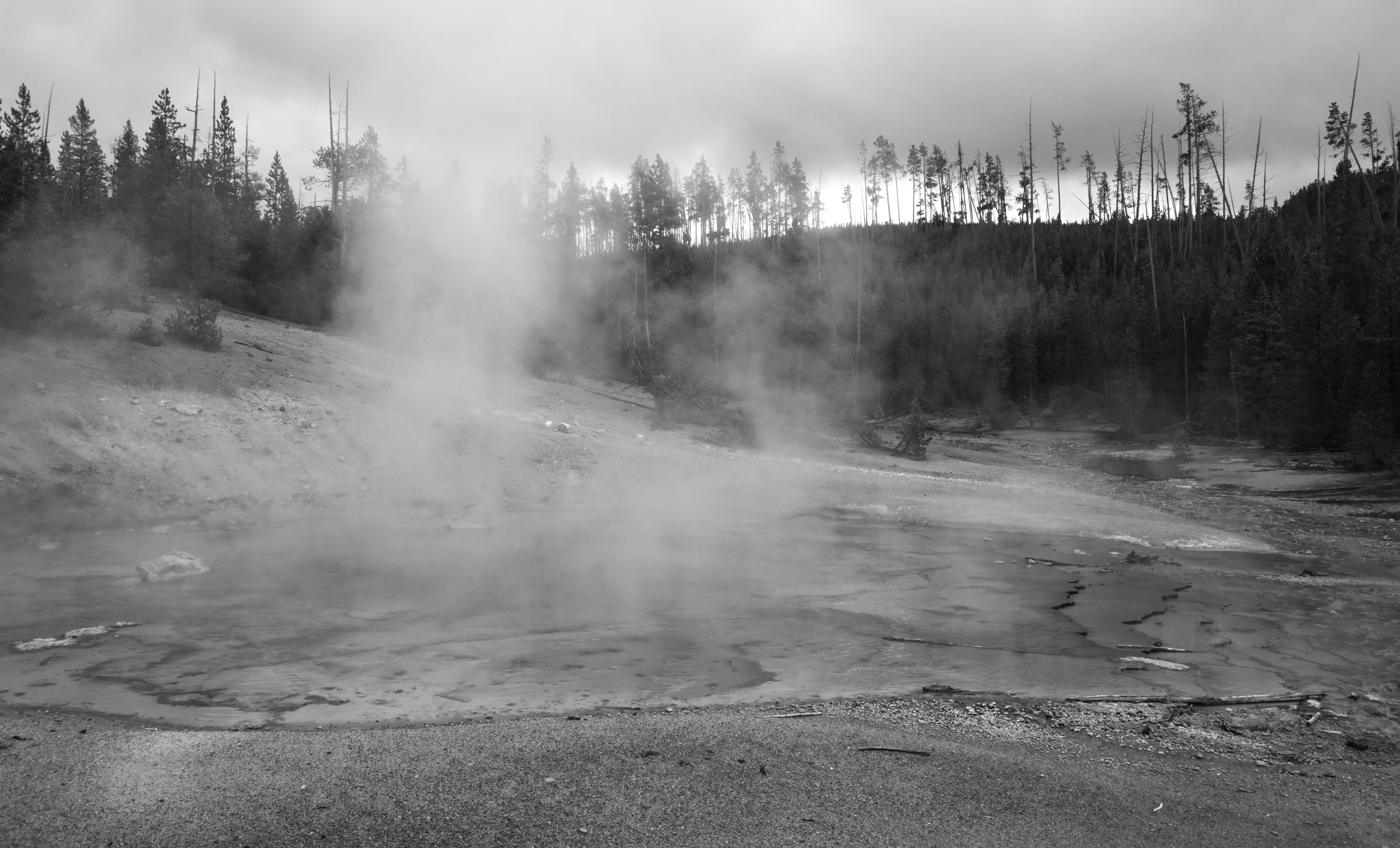
Featured in Black and White.

Several inches of fresh snow fell on Yellowstone National Park today. It was hitting our van’s windshield as we approached the park from the north, after leaving the beautiful town of Bozeman, Montana. By the time we past the gates of the West Entrance however, the snow has turned to slush and our campsite in Madison Campground was covered in a gigantic Slushy of white, muddy goo. Rather than fighting the mess, we headed out to see the park and experience the snow and the lack of crowds in America’s (make that the world’s) first National Park.

Both of us have been to Yellowstone National Park before. CT can’t remember when, but I do know that I have been here at least two or three times. Twice, I believe, as a teenager and once more about 28 years ago. For both of us, our previous experiences were filled with hot summer days and large crowds of people and cars clogging the roads.

Yellowstone Cold and Snow

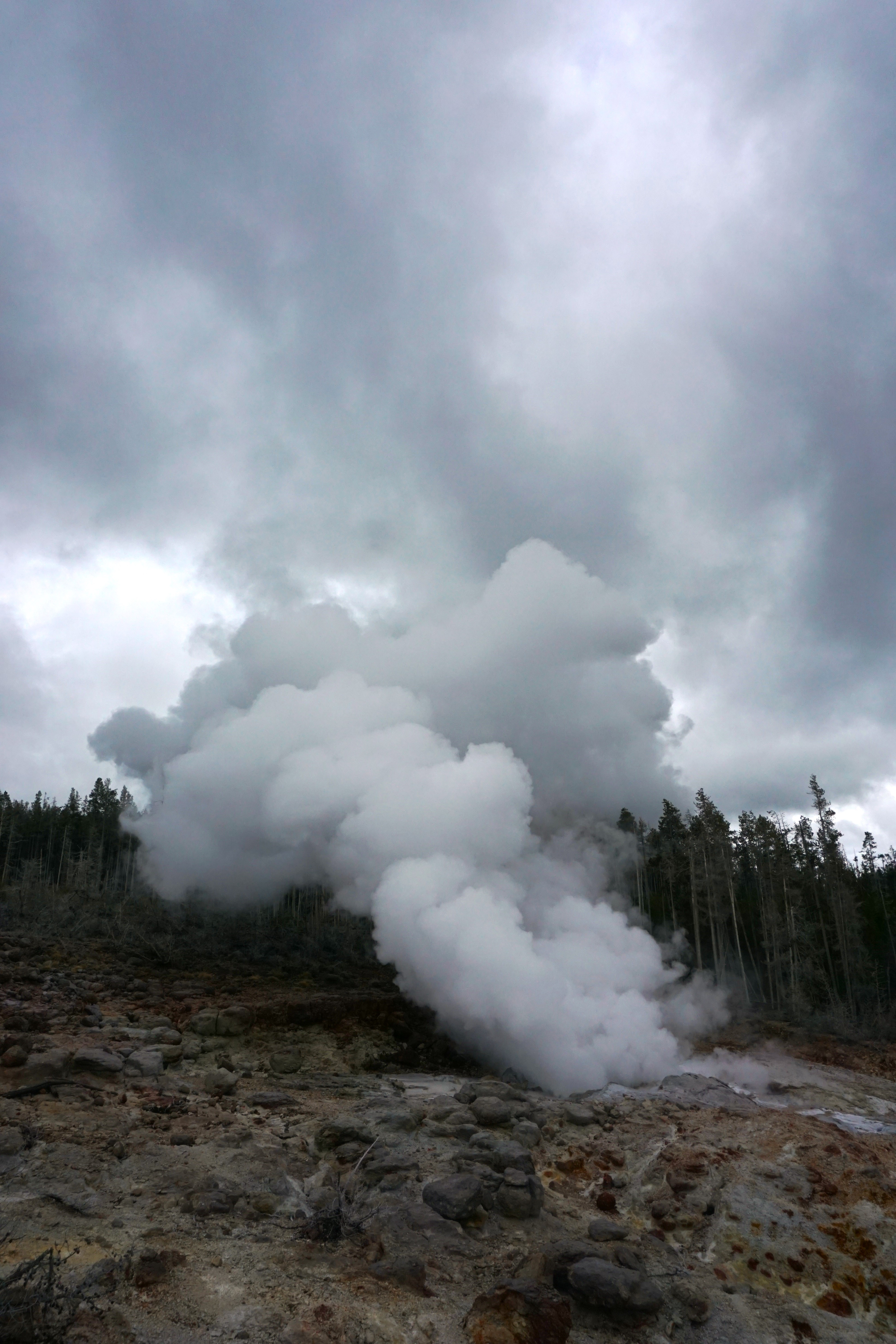
Steamboat Geyser in Yellowstone National Park. This irregular geyser blew just 3 days before our visit, blowing water and steam 300 feet into the sky.

On our first day in the park we toured several of the geyser basins, the upper and lower falls of the Yellowstone River and the Grand Canyon of the Yellowstone. Because of the snow and the near freezing air, the steam coming out of the fumaroles, geysers, waterfalls, and water pools was greatly enhanced by the temperature difference. Geyser basin steam is huge and can be seen many miles away.

Dark snowy skies and ethereal landscapes make winter weather the perfect time to explore Yellowstone National Park.
Yellowstone National Park’s Lower Falls: 308 feet or 100 meters of majesty.
The Grand Canyon of the Yellowstone on a dark snowy day.

On both sides of the canyon, the north rim and south rim, we hiked and stopped to take in the beauty and take some photos. The winter weather kept the crowds away and we had several of these lookouts to ourselves. We were concerned, however, that the cold and snow were keeping Yellowstone’s famous animals hidden up in the trees for shelter as we were not seeing any of them for quite some time. Later, on day two, the animals began to come out a little bit.

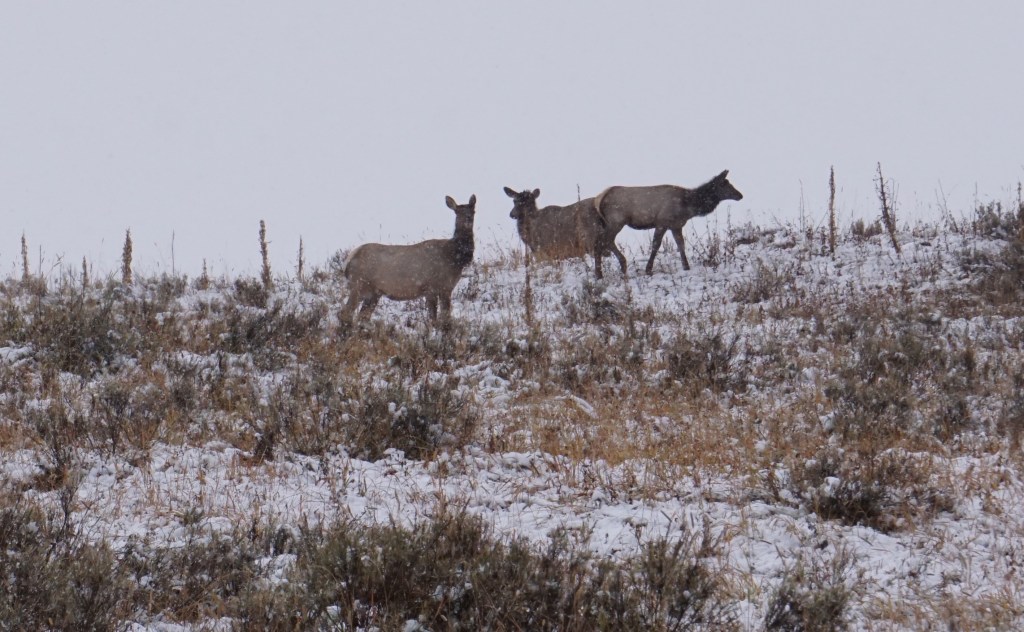
Yellowstone National Park features elk and fresh snow on this day.

Finally, some famous Yellowstone animals

During a hike on the second day we spotted a herd of elk on the top of a ridgeline. But when we arrive at Hayden Valley, where the large herds of bison, elk and other creatures are supposed to be in abundance, the open fields are completely empty. It is beginning to be a big disappointment until suddenly along the roadside and in some distance geyser basins see some bison close by.

This large bison was just off the side of the road in Yellowstone National Park
This big fella was far from the road, but seemed nonchalant about the fact that I was closing in on him. It was almost like he was modeling for the photographer.
The size and spectacle of a wild, Yellowstone bison gets the heart racing.

A Disappointing Old Faithful

Old Faithful was really late and did not reach even a small measure of what was expected.

The most popular attraction in Yellowstone National Park has always been “Old Faithful” Geyser. It is one of the most famous geysers in the world. It was named by the Washburn Expedition of 1870, who explored the area that would later be called Yellowstone. Members of the expedition entered the Upper Geyser Basin after traveling down the Firehole River and saw the geyser, which they called Old Faithful because of the regularity with which it erupted. On my previous visits to Yellowstone, I was in awe of the huge geyser. This time, however, it was a surprise and a disappointment. My past experience was that Old Faithful was highly predictable, erupting every hour or so, on average. Its maximum height ranges from 90 to 184 feet. It is also known that the water which erupts from Old Faithful has been measured at 204°F while the temperature of escaping steam can be hotter than 350°F. This time the geyser seemed to have a bad case of blasé. The geyser seemed indifferent to the fact that hundreds of spectators had driven many miles to see it and it performed poorly. It spouted off near 30 minutes past its predicted time and shot a mere 30 to 40 feet in the air. Some people got up and left before the performance was even over – like a disgusted audience at a lousy movie. I felt like doing the same after sitting on a cold bench for 40 minutes in 36 degree weather.

According to some experts, it has been acknowledged that in recent years the interval between Old Faithful’s eruptions has been getting longer. In the 1960s, the average interval between eruptions was 66 minutes, quite a bit shorter than today’s 91 minutes. It is uncertain what is causing the change. The National Park Service attributes lengthening intervals to earthquake activity, which can affect the structure of the water system below ground. Other possibilities include changes to the water table, climate change, or human activities like water diversion and construction projects.

Whatever the case may be, if Old Faithful continues to be as lackluster as this last time, the appeal of Yellowstone National Park may be lessened somewhat.

Yellowstone Lake

Jessi the adventure dog stocks the shoreline of Yellowstone Lake.

On our way out, to the south exit, enroute to Grand Teton National Park, we stopped for lunch at Yellowstone Lake. We were lucky to find a completely empty beach to picnic and let the dog run wild alone the shoreline to get the wiggles out. The water was a gray-black as it was reflecting the snow and rain filled clouds in the sky. For more than an hour we had this large expanse of volcanic sand near the boat house to ourselves. It is hard to imagine this could ever happen again.

Yellowstone National Park and a road trip through Montana.

The most impressive animal in Yellowstone National Park is the Bison: also called a buffalo.

After a glorious three days and nights in Glacier National Park near the Canadian border it was necessary to travel the north-south length of the state of Montana to reach our next destination in Yellowstone National Park. Leaving Glacier, in a way, took a very long time, as the jewels of the park were visible in our rear view mirrors for a couple of hours. Eastward, out onto the yellow grassy horizon of Montana and highway 89 and then highway 2, provided a dramatic change of scenery. The Great Plains spread out before us like a golden carpet and the misty foggy skies ahead created an ethereal splendor. We passed through little towns like St. Mary, Kiowa, Browning, Meriwether, and Cut Bank. The tiny town of Meriwether obviously named after Meriwether Lewis of Lewis and Clark fame, who traveled nearby in their historic westward exploration of the newly purchased Louisiana Territory. Cut Bank, I remembered as the smallish municipality where Christopher McCandless worked for a summer at McDonalds, hiding out from his hideous parents, as portrayed in the Book and subsequent movie “Into the Wild.” McCandless eventually died in a deserted bus in the wilds of Alaska, starved to death, in an almost suicidal effort. It was a bit strange to pump gas into the van and shop in the Albertsons grocery store in the same complex as the very same McDonald’s where he worked.

The journey to Yellowstone National Park continued with brushes past Great Falls and Helena (the state capital) and other non-notable locations, but we found the town of Bozeman to our liking and checked into a Hotel for two nights to catch up on shopping and laundry. We even filled up the adventure van with gasoline again at the really cheap price of $3.49 a gallon (half of what the price was in California just before we left.)

Bozeman, Montana

The mountains around Bozeman, Montana.

Bozeman is a city located in the southwestern part of Montana, United States. It is the county seat of Gallatin County and has a population of 53,293 as of 2020. The city was founded on August 9, 1864, and named after John Bozeman, a pioneer and frontiersman from Pickens County, Georgia 1. The city is situated at an elevation of 4,817 feet (1,468 meters) above sea level. The city has a rich history and was primarily within the territory of the Crow people. For many years, indigenous people of the United States, including the Shoshone, Nez Perce, Blackfeet, Flathead, Crow Nation and Sioux traveled through the area, called the “Valley of the Flowers”.  In 1863, John Bozeman opened the Bozeman Trail, a new northern trail off the Oregon Trail leading to the mining town of Virginia City through the Gallatin Valley and the future location of the city. Bozeman has been one of Montana’s fastest-growing cities from 1990 into the new millennium. At the rate of three percent, Bozeman could surpass Great Falls as Montana’s third-largest city by 2025.  The city is known for its nearby recreation, scenery, and quality of life. When we arrived in Bozeman it was even a balmy 74 degrees and the colors on the mountains were in full form.

We were so impressed with the beauty, the people, the charming old ( but functioning ) downtown, the amazing place we ate for two consecutive nights called the Montana Ale Works, and just the general vibe we experienced. In fact, we put some thoughts to maybe moving here one day…. then the weather turned… and we remembered that there may also be some nasty and cold months here.

After checking in to the hotel, we made haste to an Indigenous People’s Day celebration in Bozeman.
Montana Ale Works was far more than beer. We experienced some of the best dishes anywhere. We ate here two nights in a row.
We even took the time in Bozeman to crash the headquarters of Oboz Footwear – makers of our favorite boots. I’m on my 11th pair.

South to Yellowstone National Park

Our original route to Yellowstone was leaving Bozeman on Interstate 90 to Highway 89, where we could enter through the North Gate and see the Albright visitor’s center. Heavy snow began to fall outside of Bozeman and we redirected to a safer weather route and went to the West Yellowstone entrance instead. We checked in to Madison Campground for two nights. It would be the last few days anyone would be here, as all the Campgrounds would be closing for the winter. The ranger joked with us that the “place is shutting down, We close the campgrounds, lodges, roads… turn off the geysers and lock up all the animals.” We soon realized that we were getting our visits in just before the lid was closed up on both Glacier National Park and Yellowstone National Park.

Glacier National Park

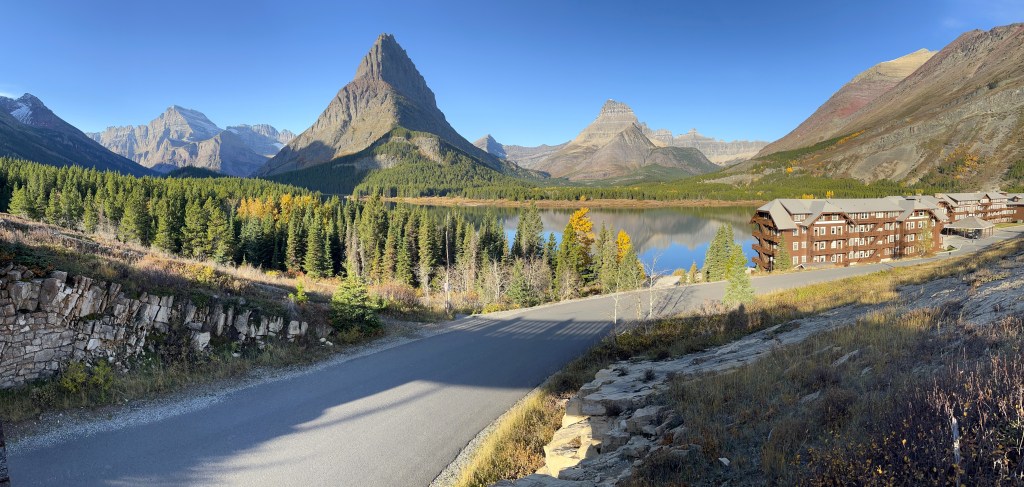
Glacier National Park is nothing less than magical. The view behind Many Glacier Lodge.

Our boondocking spot just outside Glacier National Park was safe and quiet and extremely cold. After coffee in the van, I opened the sliding door to a slap-in-the-face 31 degrees F. We quickly made the decision to get dressed, drive to Apgar Visitor’s Center, park in the lot and make breakfast there. It was a good idea, as we had a flat surface to make food and a set of warm bathrooms with flush toilets which were open even though the Visitor’s Center was not.

Glacier National Park is a national park located in the northwest corner of Montana along the spine of the Rocky Mountains, adjacent to Waterton Lakes National Park in Canada. The park encompasses more than 1 million acres and includes parts of two mountain ranges, more than 130 named lakes, more than 1,000 different species of plants, and hundreds of species of animals. The park is known for its seemingly endless acres of rugged and breathtaking landscapes. With over 700 miles of trails, Glacier is a paradise for adventurous visitors seeking wilderness steeped in human history.

The Road to the Sun

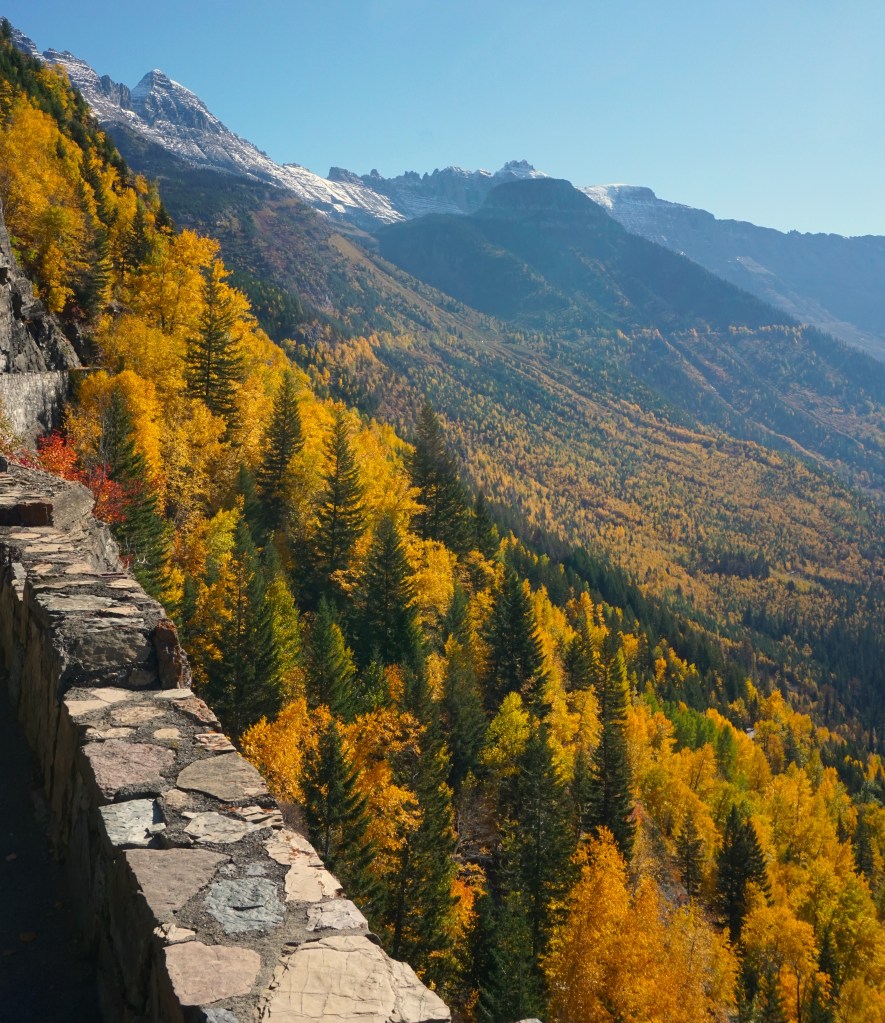
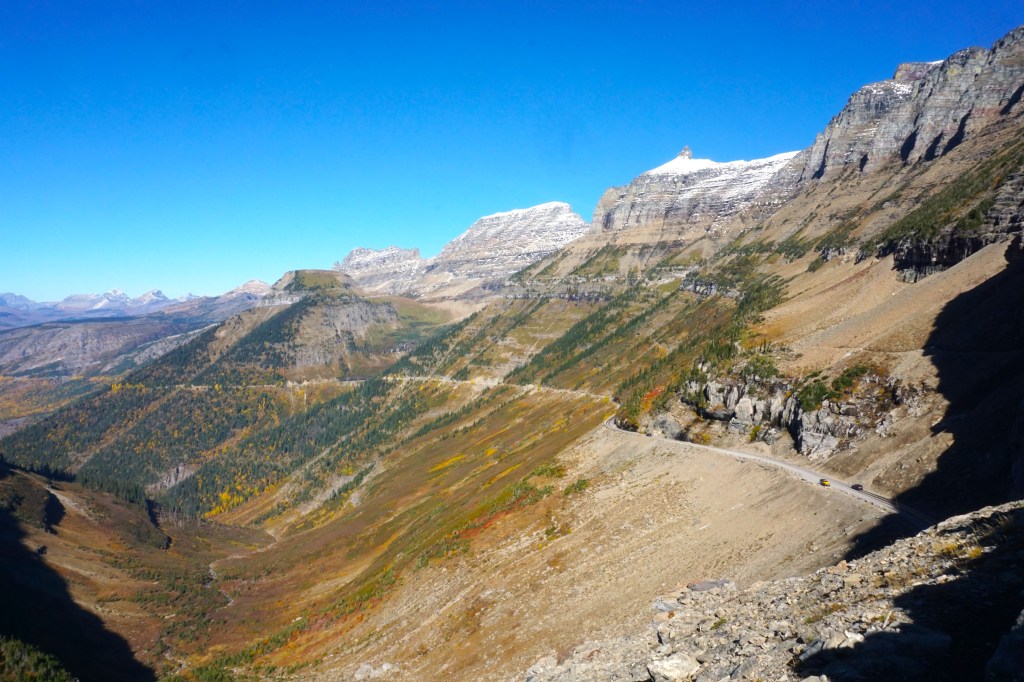
Fall colors and a fresh dusting of snow made the Road to the Sun drive even more amazing this time of year.

Going-to-the-Sun Road is a scenic mountain road in Glacier National Park. We had been looking forward to this drive for a long time, but we were worried that it would be closed by the time we arrived at the park. The Going-to-the-Sun Road has a hard closure date of October 15 this year, but it can be closed earlier if winter arrives. We are in luck with a beautiful weather window. Although it was freezing cold in the morning, the day warms into the 60’s and 70’s later in the afternoon. Going to the Sun is the only road that traverses the park and crosses the Continental Divide at Logan Pass, which is the highest point on the road at 6,640 feet or 2,025 meters in elevation.

The Going-to-the-Sun Road is one of the most iconic roads in North America. We were lucky to make the drive before it closed for winter.

The road spans 50 miles (80 kilometers) and offers views of glaciers, valleys, waterfalls, mountains, and in the Summer months, wildflowers. We have learned that construction of the road began in 1921 and was completed in 1932. The road is named after Going-to-the-Sun Mountain which dominates the eastbound view beyond Logan Pass. One Native American legend concerns the deity Sour Spirit who came down from the sun to teach the Blackfeet the basics of hunting. While returning to the sun, an image of Sour Spirit was placed on the mountain as an inspiration for the Blackfeet. Another story has suggested that a late-19th-century Euro-American explorer provided the mountain’s name and the legend. Either way, we found the road to be a can’t miss adventure in Glacier National Park.

The road is notable as one of the first National Park Service projects specifically intended to accommodate automobile-borne tourists. It is both the only link between the east and west sides of Glacier National Park and the only extensive automobile route in the park. The road defines Glacier’s basic circulation pattern and receives heavy amounts of traffic during summer months. Although we did not face too much traffic in the month of October, it was still a scary and exposed drive for those who have a fear of heights.

Hiking Trails in Glacier National Park

CT finds the going easy on the Avalanche Lake Trail in Glacier National Park

We made use of many little trails campground tours while walking Jessi, our Lab Shorthair mix adventure dog, but our four main hikes during our time in Glacier were Avalanche Lake, Highline Trail, Hidden Lake Overlooks and Grinnell Glacier Trail.

Avalanche Lake was fogged in when we arrived at its shore.

Avalanche Lake trail is about 4.5 miles long and has an elevation gain of 741 feet. The trail begins at the Avalanche Lake Trail Head which is a large parking lot just past the nine-mile point on Going-to-the-Sun Road. Early on, there is a fast flowing creek which has carved beautiful, flowing paths into the reddish-brown argillite and quartzite rock that was compressed under sea water and exposed to oxidation. We had the trail to ourselves at first, but soon we had to share the trail on the way down with what seemed like busloads of tourist. This is a common issue with the easy, but beautiful trails we hike.

A view of Going-to-the-Sun Road from Highline Trail.

Later in the day, when we reached Logan Pass, we found a parking spot and did a partial trek on The Highline Trail and the full length of the Hidden Lake Overlook Trail.

The views on the Hidden Lake Trail were worth the effort.

Both of these were spectacular and highly recommended. The highlight hike of our three day stay in Glacier National Park however, was the Grinnell Glacier Viewpoint Trail.

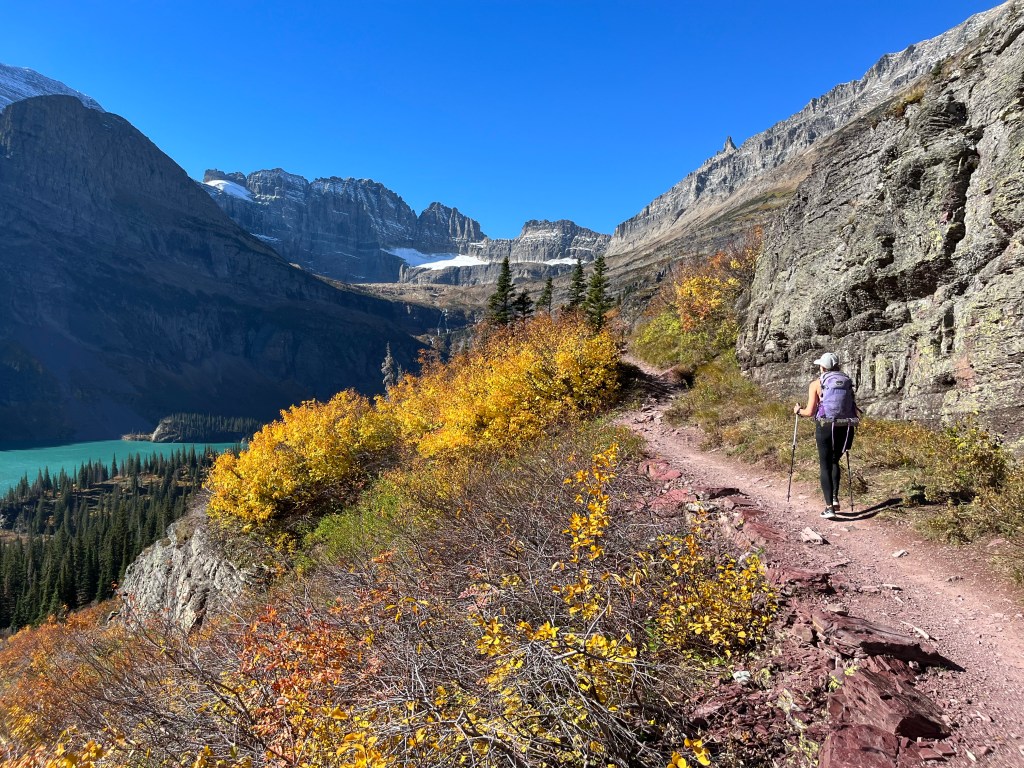
CT at the one-mile mark of our trek to Grinnell Glacier, found high in the cliffs in the background.

After our drive over the Continental Divide and over to the East side of the park, we were able to secure a campsite in Many Glacier Campground for just $10 per night. As the camp was basically shut down for winter – with no services, or water or open bathrooms… it was highly discounted. After a relaxing morning and a hearty breakfast, we set out to make it to the end. The trail would be 12 miles from our campsite and a steep, lose, and often cliff-side 2,600 feet of elevation gain on the way up. This is the kind of trail which is far less populated with casual tourists.

It is only mile two but, it is already heating up. We shed some clothes and trek on. Some of the glaciers and snowfields can be seen in the cliffs above.

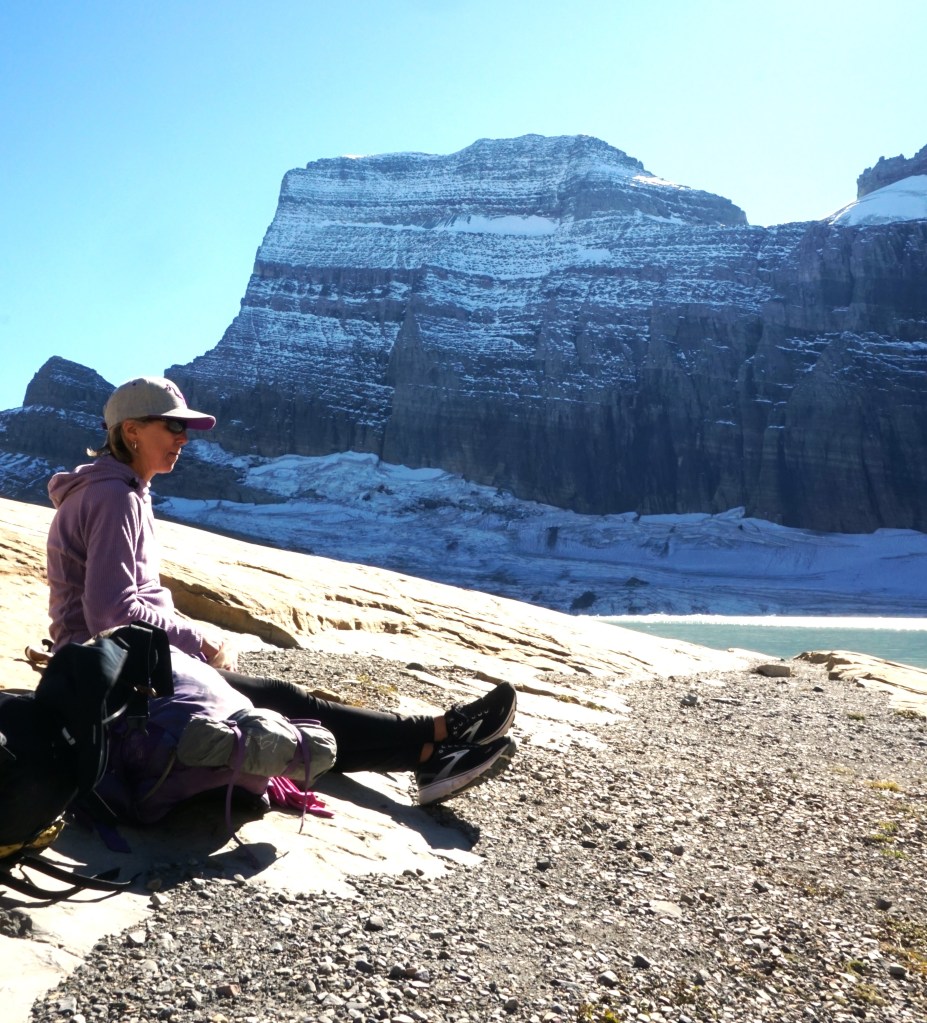
The glacier-fed lakes and the red and yellow fall colors are magical and as the air thins out and the climb gets steeper, our spirits are lifted by the sheer radiance of the scene. After more than three hours of climbing, we reach Grinnell Glacier and the grey, silt-filled lake which floats its calved icebergs. We are tired, but we lay out on the hard rock surface like it is a king-size bed and rest. The sun is hot and the wind is cold here. We are troubled about what to wear, as we are both feeling sunbaked and frozen at the same time.

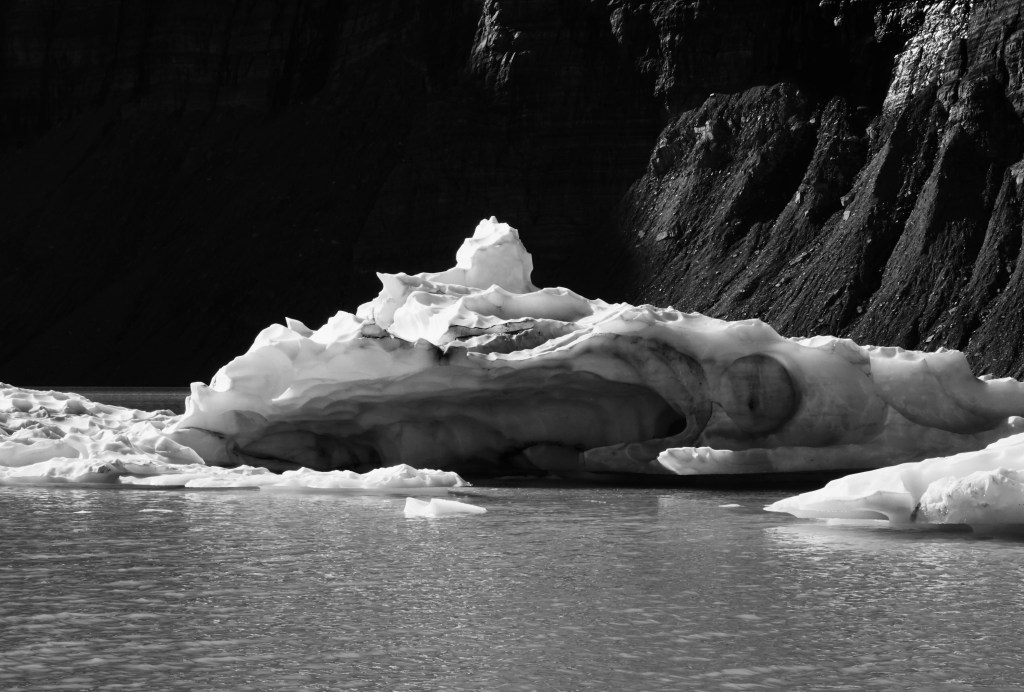
Fire and Ice. On the shores of Grinnell Lake
Grinnell Lake, a calved iceberg and the dark cliff behind in Black and White.

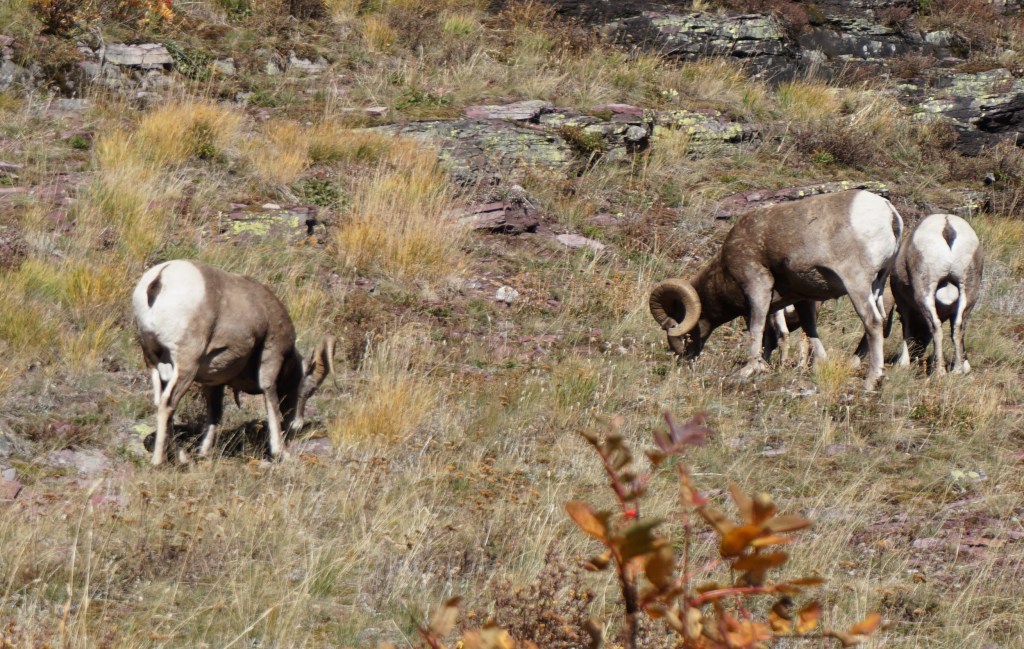
We munch on energy bars, an apple and electrolyte infused drinks for lunch and then gear up to make the six-mile downward trek to camp. Just when the pain begins to set in deeply and for a few days to come… we run into some big horn sheep and take a long break to enjoy their beauty and chuckle at their indifference to us.

Big Horn sheep above the Grinnell Glacier Trail.
The views from Grinnell Glacier Trail in Glacier National Park are amazing

The last mile of the hike is painful for me. I seem to be hurting from every joint and muscle. It is a struggle to make it back to camp. CT encourages me well and I trudge on. Back at camp we set a big fire and enjoy a delicious meal and a good bottle of wine as the sun sets behind the mountain. The golden leaves of the aspens which surround our camp have fallen on our site all day and leave a thick bed of color coating our van and picnic table. It is gorgeous. It is our last night in Glacier National Park. We are glad we came.

Road Trip to Glacier National Park

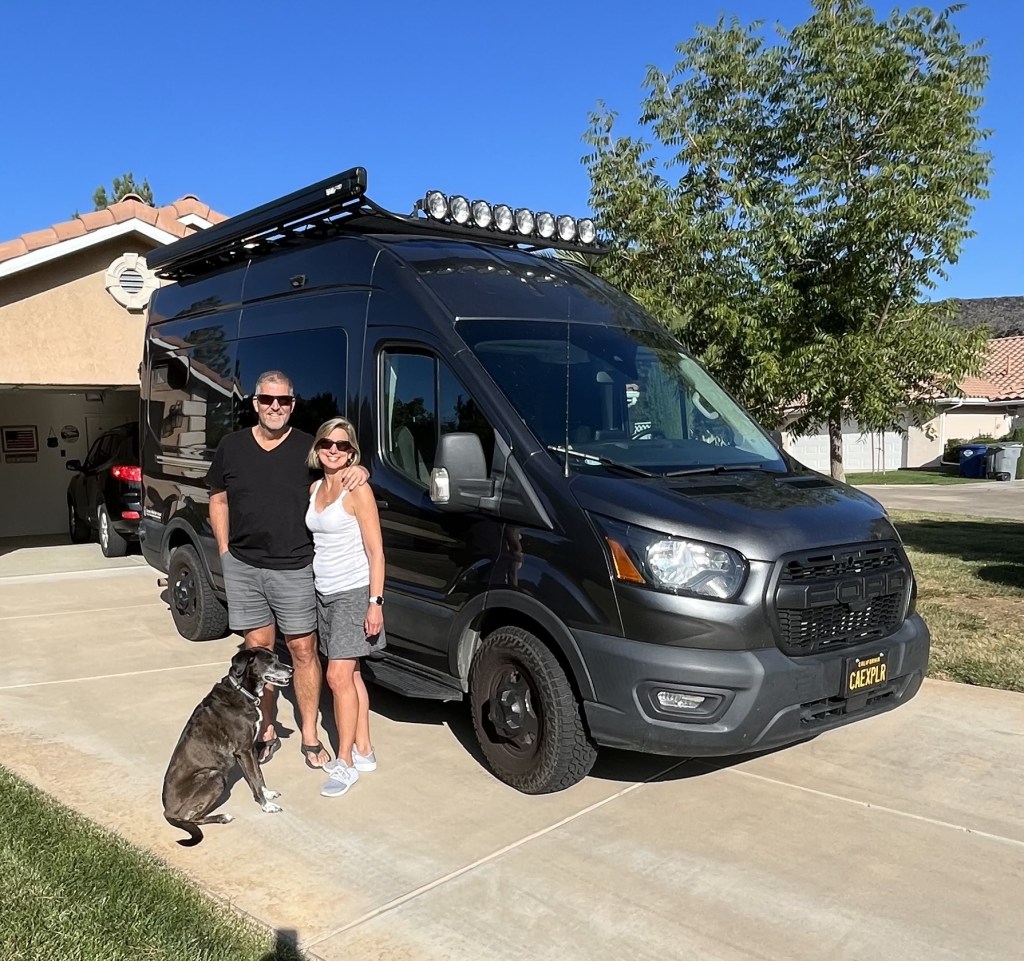
The California Explorer on the Road to the Sun in Glacier National Park

The Drive

When we planned our journey around the United States, the anticipation of some long driving days was part of the bargain you make with yourself to see the the wonders of nature and enjoy the changing scenery. Our trip for this section began in Idaho Falls, Idaho where we stayed the night in a Hampton Inn to rest from the small confines of the van and soak in a warm shower to our heart’s content. Yesterday’s drive was some 450 miles after we left Great Basin National Park and today we will cover another 400 plus miles to arrive at the west entrance to Glacier National Park and hopefully a spot in the Apgar campground.

A Friendly Beginning

Knowing that we would be camping in a semi-closed campground, or even spending the night in a boondock spot, we needed to fill the water tank to it full capacity of 30 gallons. In addition, it dawned on me, as I lay awake in the middle of the night, that we had never checked the air pressure in the spare tire the entire year and a half that we had owned the van. Sometimes the simplest things can be forgotten, it seems. After fueling up at a Wal-Mart gas station, where we found on the Gas Buddy App was the cheapest place in Idaho Falls, we tried our luck the the Wal-Mart Automotive center to see if they would check the spare tire for air pressure. If we were even luckier, we may find a hose and fill up the water tank. One of the young men working in the shop was friendly and happy to help. He even stopped the work on a paying job to help us out with both problems. It was a good move as both tire and tank were very low. While I am almost never a Wal-Mart shopper at home in California, you can find good people and good companies everywhere, and usually when you do not expect it.

A Change of Scenery and a New Road

The route from Idaho Falls to Apgar Visitor Center in Glacier National Park turned out to be one of the most beautiful western road trips I have taken. Once we leave Idaho Falls, the empty spaces of pale green sagebrush and dry grey earth, so prevalent in the flat areas of the western states, changes to golden grassy prairie and rolling hills between majestic mountains, dotted with forest-green pines. I had never been north of Idaho Falls and a sojourn into Montana’s Rocky Mountains is a first for me. The prevailing notation as we drive, is how many lakes and rivers are around every corner and new sightline. Route I-15 and then a change to I-90 delivers scenic pleasure on all fronts. There are many overlooks and mountain passes through several small towns and modest cities like Dillon, known for its rich history and outdoor recreational activities and Missoula, a city located in western Montana, known for its vibrant arts scene, museums, and outdoor recreation. I have always wanted to see Missoula, as some of my past business acquaintances from the area often told me that “if you have to live in Montana, you want to live in Missoula.” Until now, I have just had to take their word for it. Missoula is lovely and we wish we could stop and visit, but we are trying to reach Glacier National Park and the Apgar Visitors Center before it closes.

Flathead Lake

Most the the last hour of so of our trip to Glacier National Park is dominated by the long drive along the eastern shore of Flathead Lake. The lake is huge and beautiful and unexpected. It is the largest natural freshwater lake west of the Mississippi in the lower 48 states, with over 200 square miles of water and 185 miles of shoreline. The southern half of Flathead Lake is within the boundary of the Confederated Salish and Kootenai Tribes Flathead Reservation. Montana Fish Wildlife and Parks maintains thirteen public access sites around the lake but what we notice most of all is how few homes are nestled on its shores. Cattle graze on grass and alfalfa right down to the waters edge and the eastern shores are filled with gigantic cherry tree orchards. Dozens of cherry stands line the drive on Highway 35, where you can buy cherries by the pound or bucketful. As a Californian, this lake seems like prime real estate, and we marvel at how much empty land surrounds the beautiful lake. One hiker we met from the area noted our surprise at this and he jokingly, but with a rueful tone said: ” Yes, there are not 10,000 homes around the lake, there are a few hundred 10 million dollar homes instead.”

West Glacier National Park and Lake McDonald

CT and Jessi take a stroll. Lake McDonald in Glacier National Park provides a great place to walk off the long drive and see the fall colors.

Once we reach the outskirts of Glacier National Park, are greeted by stunning views of snow-capped mountains, pristine lakes, and lush forests. A recent snowfall has given a look of what CT says is “a sprinkling of powdered sugar” on the upper peaks. Lake McDonald is best known on instagram, where influencers get their post photo at the lake’s edge. Under-the-surface multi-colored rocks and distant mountains provide the clickbait. The wind and wave on the lake prevent such a photo today, but we are content to walk and take in our first views of the stunning glacier carved peaks in the distance. The Apgar Visitor Center is located near the west entrance of the park and offers a variety of services such as information on park activities, exhibits on park history and culture, and a giftshop. We ask loads of questions and get great answers about hikes and bear issues. Luckily, the hikes we hoped to do have not been closed to grizzly activity (some have) and we will go on our hikes with bear spray at the ready. The ranger we speak with tells us that Lake McDonald is the largest lake in Glacier National Park. It is approximately 10 miles long, over a mile wide, and 472 feet deep. We learn that like many of the features here in the park, the lake was formed from a combination of glacial activity and erosion. The lake is surrounded by a dense coniferous forest dominated by various species of spruce, fir, and larch. Grizzly bears, black bear, moose, and mule deer are found in many places near the lake but are most common on the north shore.

Boondocking or “Dispersed Camping”

Apgar campground, near Lake McDonald is nearly closed down and for the sites that do remain open this time of year…. they are full. In fact, most of the park’s infrastructure is shuttered, and what is not already closed, preparations are being made for a winter lock-down. All the lodges, hotels, KOA’s, and other local, just-outside-the-park amenities are also closed for the season. We are resigned, but hopeful that we can boondock just outside the park. The ranger called it dispersed camping, and gave us some options far away near another lake. We found instead, a quite road with some little cabins and closed up lodges where there was a trailhead parking area. We tucked the van up in the wooded space, got things leveled out, made dinner and went to bed. It worked out fine. No one bothered us.

Great Basin National Park

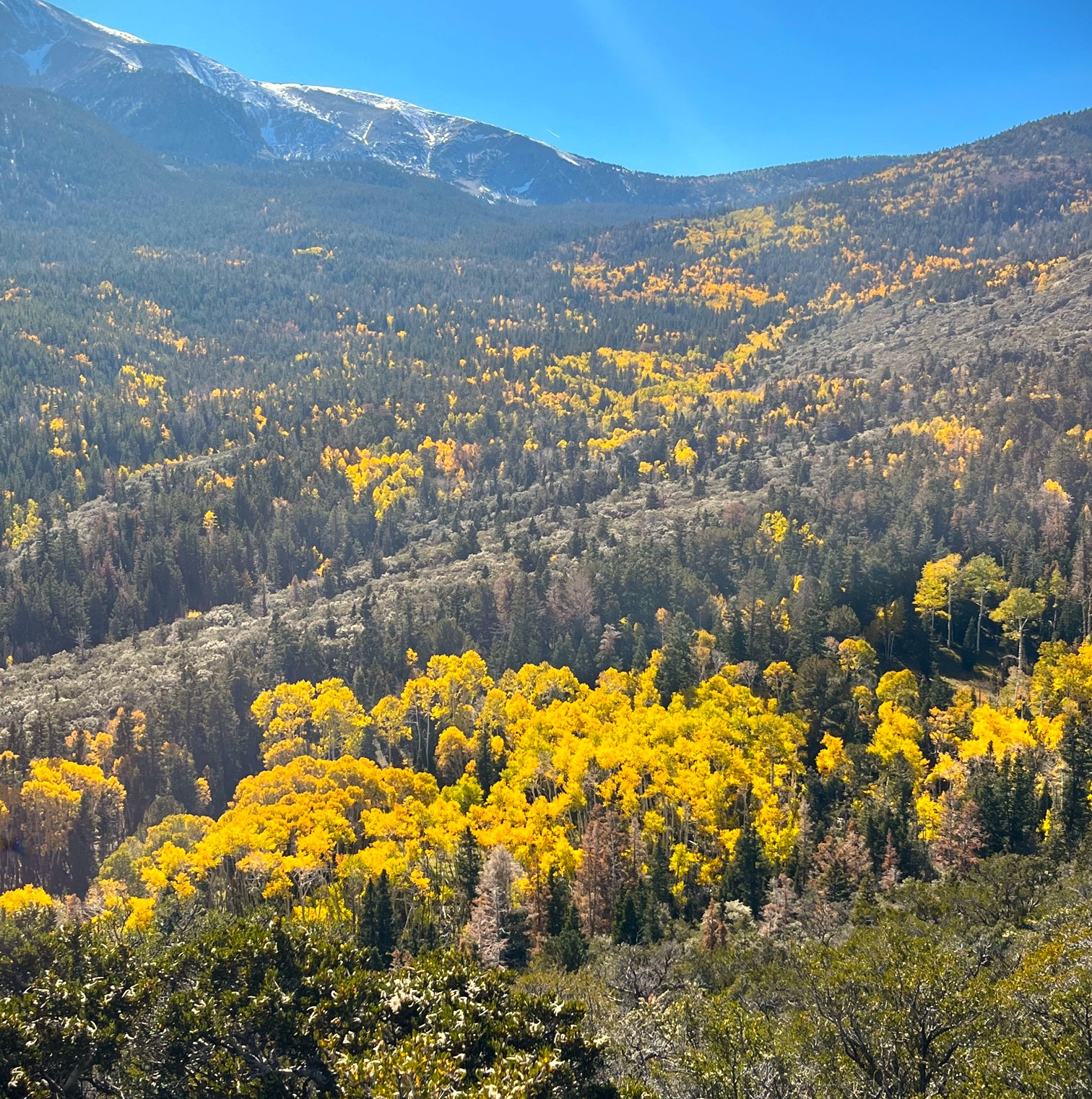
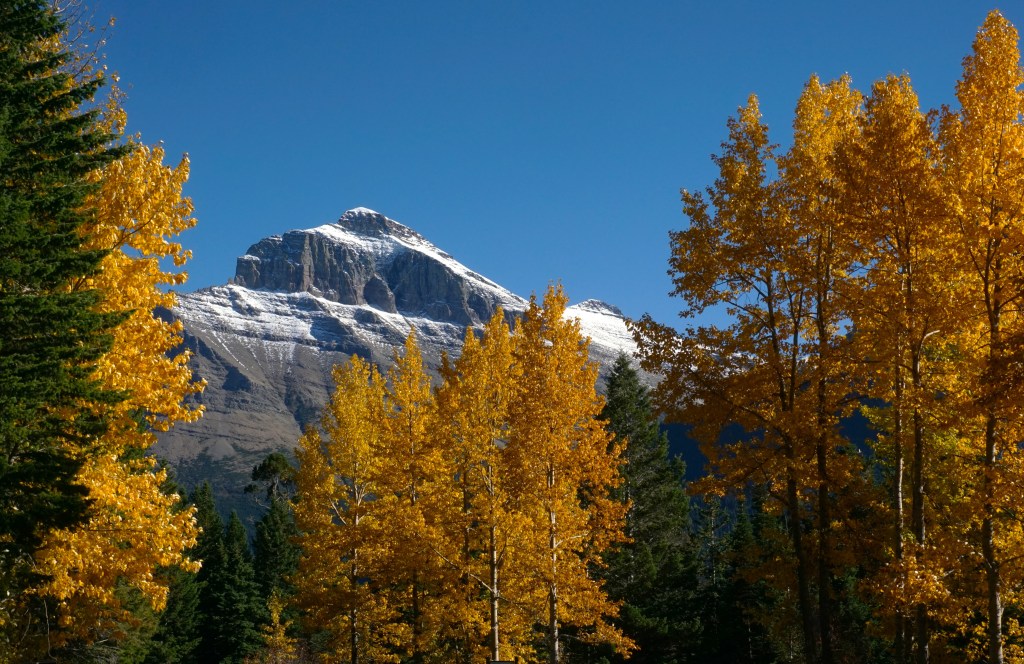
Wheeler Peak in Great Basin National Park through the fall colors.

Great Basin National Park: A Hidden Gem in Nevada

Great Basin National Park is one of the lesser-known national parks in the United States, but it offers a variety of natural and cultural attractions for visitors like us. Located in east-central Nevada, near the Utah border, the park covers 77,180 acres of land that showcases the diversity of the Great Basin region, The drive to get to the park is not easy and covers hundreds of miles over empty and desolate ground covered with sage brush and dry earth. We started north from St. George on I-15 Freeway before changing to Highway 21, passing through the towns of Milford and Garrison, where we could see historic buildings and old mines. As you cross the border into Nevada, we entered the Great Basin, a vast region of mountains and valleys that covers most of the state. You will arrive at Baker, The trip is about 220 miles long and takes about four hours to drive.

We drove by two of these signs of different roads along the way to and from Great Basin National Park

The park is named after the Great Basin, which is the largest area of contiguous endorheic watersheds in North America. The region is bounded by the Wasatch Mountains to the east, the Sierra Nevada to the west, and the Snake River Plain to the north. The south rim is less distinct. The Great Basin includes most of Nevada, half of Utah, and sections of Idaho, Wyoming, Oregon, and California.

Bristlecone Pines

Perhaps my favorite park of our evening hike was finding the rare Bristlecone Pines. Great Basin National Park features a range of ecosystems and habitats, from sagebrush-covered foothills to alpine meadows and peaks. The park is home to 11 species of conifer trees and over 800 species of plants, some of which are endemic to the area. One of the most remarkable plants in the park is the Great Basin bristlecone pine, which is the oldest known living non-clonal organism in the world. Some of these ancient trees are over 5,000 years old and grow at the tree line near Wheeler Peak, the highest point in the park at 13,063 feet.

This Bristlecone Pine is 3,200 years old and is still producing live branches. We arrived at the grove just before dark.

Hiking in Great Basin National Park

CT treks along Stella Lake in Great Basin National Park

We took the opportunity to complete on long hike in the evening just after setting up camp in the Upper Lehman Creek Campground. We wanted to stay at the Wheeler Campsites at 10,000 feet elevation, but they were closed just before our arrival. Our hike started at the wheeler Peak trailhead and took us by two alpine lakes and the Bristlecone Pines. It was about six miles and took a bit longer than two hours. All of the hike was at an altitude we had not been in a while, so it was a great workout.

Doing my best to keep up at over 10,000 feet in Great Basin National Park

Great Basin National Park is a hidden gem in Nevada that deserves more attention and appreciation from travelers who are looking for a unique and diverse experience in nature. The park offers something for everyone, whether it is hiking, caving, stargazing, or simply enjoying the solitude and beauty of the wilderness.

Camping and Stargazing

We woke early, made coffee and a roaring fire while the stars were still brilliant in the night sky.

Great Basin National Park also boasts some of the darkest night skies in the contiguous United States, making it an ideal destination for stargazing and astronomy enthusiasts. The park offers free ranger-led astronomy programs every Wednesday, Thursday, and Saturday from May through September. Visitors can also enjoy viewing the annular eclipse that will occur on October 14, 2023 at Great Basin National Park. We did not have time for a ranger lead program, but we did see some of the brightest stars we have ever seen.

On our way out of the park we stopped to take in the unique entrance sign at Great Basin National Park.

After an evening of hiking, a night and early morning campfire and stargazing, we made an early start for the 450 mile drive to Idaho Falls, Idaho. The day was filled with a scenic road trip that took us through some of the most diverse and beautiful landscapes in the western United States. We hoped to stop in Twin Falls, Idaho and see the “Niagara of the West” Shoshone Falls, but the road was closed for repairs and we were turned away with just a mile to go. Not everything on this long road trip will be perfect, but we are creating perfect opportunities at least.

Follow / subscribe to this blog and follow us on our journey across the United States.

Journey to St. George

A trip all the way across the United States and back must have a beginning. For us, it was the long drive from Southern California to St. George, Utah. This is an excellent launching point for us, as it is the home of my mother. A few days spent visiting her is always nice, and then we are ready to begin the 12,000 plus miles of driving to see the country. As always, the drive through the deserts of Eastern California and Southern Nevada is filled with vistas of empty, beautiful landscapes. We marvel at the pinnacles which jut up to the sky as we drive down Highway 15 on the decent into the City of Baker. As the sun sets, the distant purple mountains majesty become a real thing and not just a line in the song we sang as school kids. Our journey to St. George is just a start. We plan to explore many, many State and National Parks along the way and hike about a million miles over the next few months.

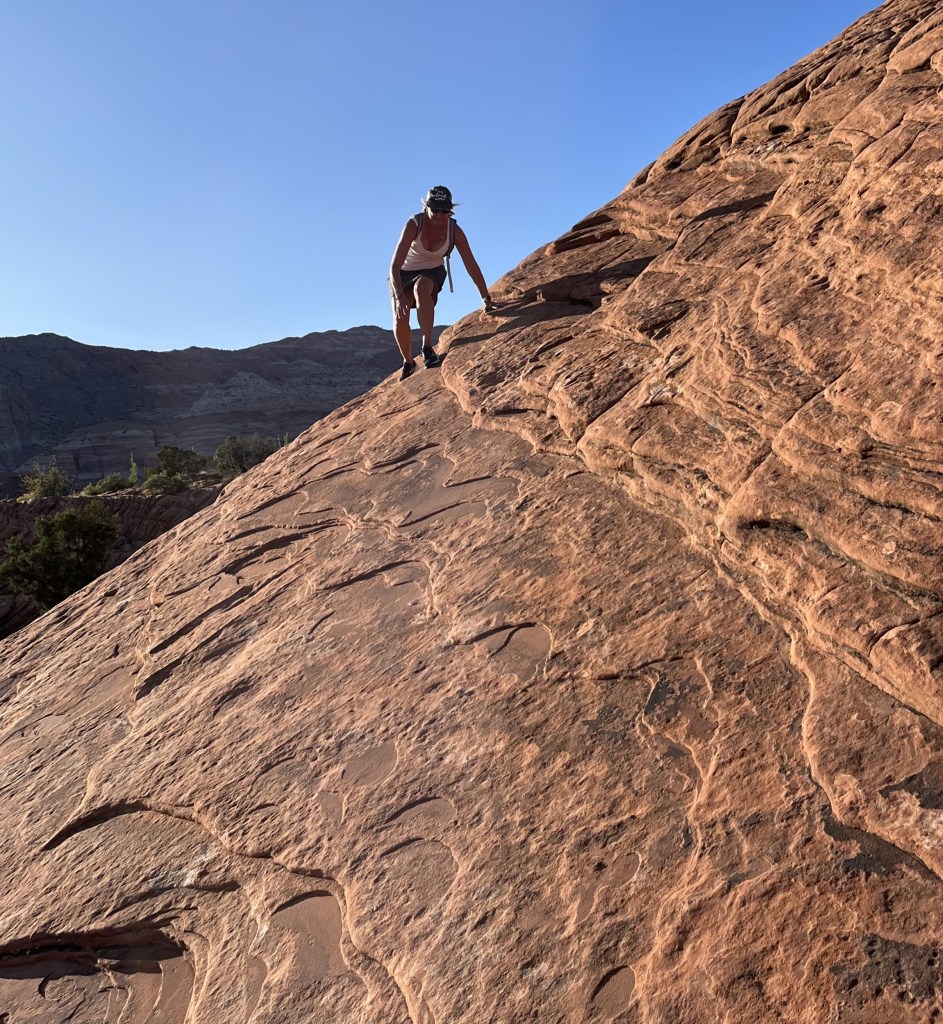
CT traversing the Lava Trail in Snow Canyon State Park near St. George, Utah

Snow Canyon State Park

One of the most spectacular state parks in all the the United States is Snow Canyon State Park near St. George, Utah. We have visited this park on a few other occasions and it never gets old. The park is only a 20 minute drive from downtown and the entry fee is $15 for out-of-state visitors.

I found the rock in Snow Canyon State Park to be an extraordinary exploration.
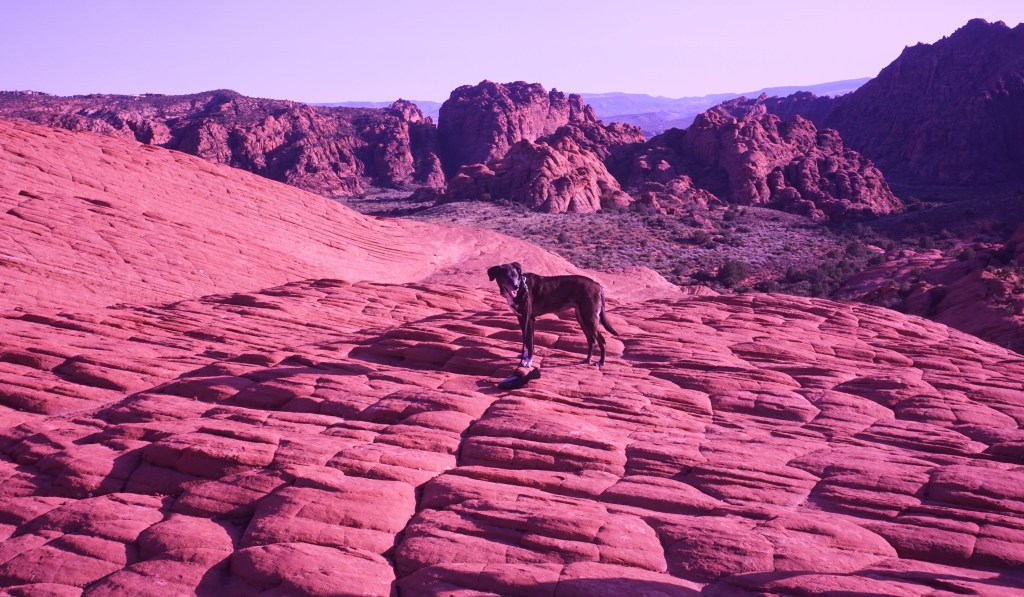
At sunset, Jessi, the Adventure Dog loves Snow Canyon State Park too.

It has been said by others too, but I have long contended that Snow Canyon State Park is so special that if it were in other states around the country, which are not already loaded with so many National Parks, it would be a National Park too. There are trails all over the place and several entrances, but the main section, which should not be missed is the hiking and viewing areas along Snow Canyon Drive. This section of road closes down for a few days each October for the St. George Marathon. It is known as one of the most scenic and enjoyable marathons in the world.

I am headed out to one of the many scenic overlooks in Snow Canyon State Park.

Snow Canyon State Park is great any time of day, but we found some special photo opportunities at sunrise or sunset. Summer is very hot too. June, July and August will be more than 100 degrees Fahrenheit during mid-day.

Climbing on and around the rock trails in Snow Canyon State Park can be a bit treacherous.

The next day brings us back into Nevada after a long drive to Great Basin National Park,

Cal Fire Forest Clear-Cutting Meeting Results in Hostility 

By Keith Alan Robinson

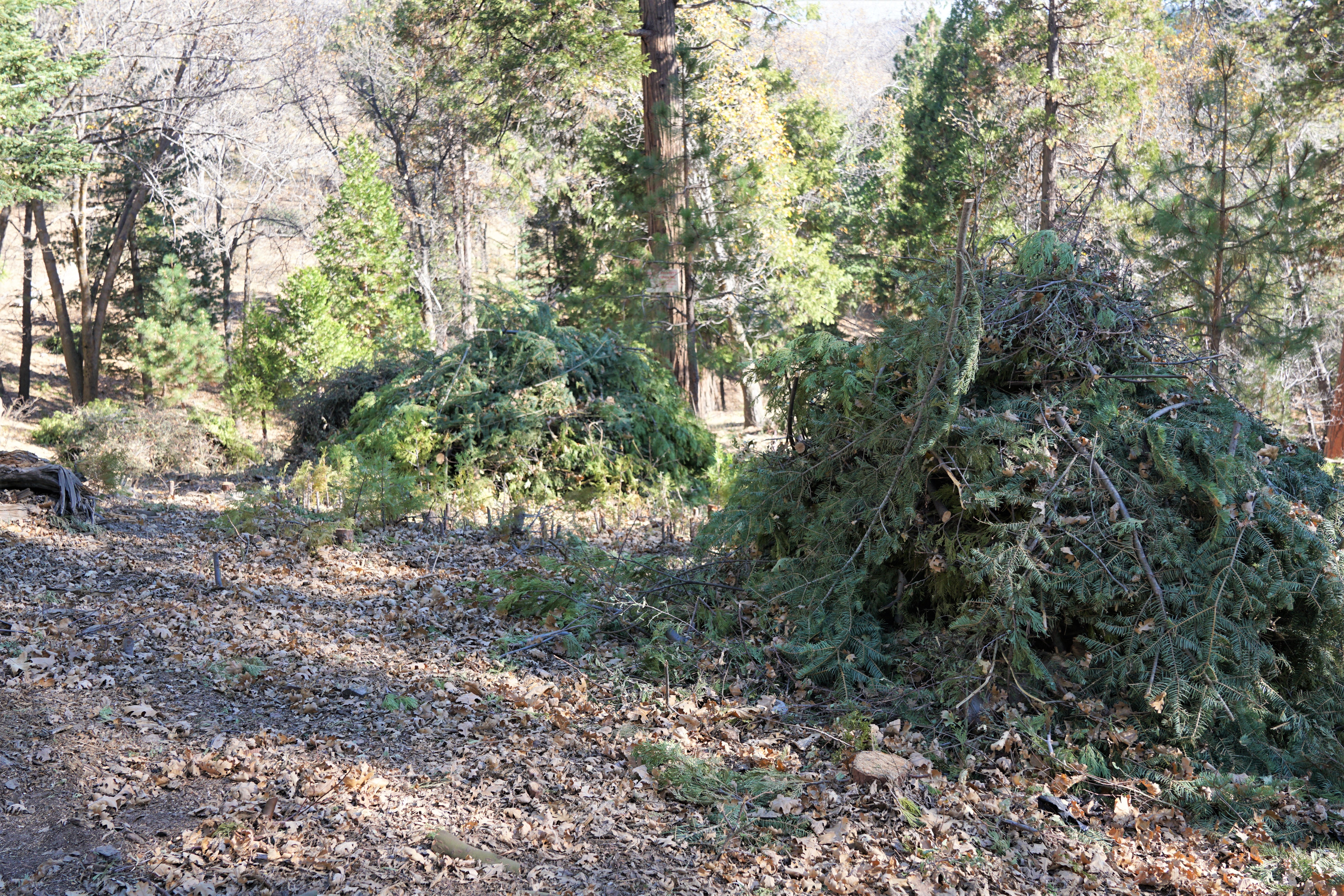
Cal Fire’s tree destroyer: The Bandit

It can be rather uncomfortable to be put on the spot.  Especially, when you have something to hide.

Some of the board members of the Upper Little Bear Community Home Owners Association near Blue Jay recently enlisted Cal Fire to mitigate fire hazards on their property and some of their own residents do not like the results – or, the way it was forced upon them. 

Additionally, claims about misuse of authority and “the sneaky way it all happened” have made many residents feel steamrolled.

A meeting was scheduled for Sunday November 21st and forestry expert, Dr. Chad Hanson was called in to offer an alternative viewpoint to how the forest should be dealt with.  The meeting did not start well.

“Why are you here?”  

“This is a private meeting.” 

“No one invited you.” 

“You are on private property, get out of here!”

“Why is the press here?”

This set of questions and demands were not just spoken, but shouted rapid fire and with intensity by two of the board members of the Upper Little Bear Board directed toward the Mountain News and others at the intersection of Golf Course and Old Toll Roads in Lake Arrowhead.  This reporter thought he was about to be punched in the face.

Before long, several other press members from San Bernardino showed up and helped to prevent an act of violence, which seemed to be forthcoming.  Ed Reichardt, the HOA President, who would not talk to press or even identify himself, stomped around and fumed like a kid who just got caught with his hand in the cookie jar, and now he seemed to be looking for a fight.  Over the course of an hour, he repeated the complaint: “Why is the press here?” more than a dozen times.

The small contingent was a bit mollified when it was suggested by another Upper Little Bear resident that the reporters were eager to hear both sides of the story and another resident reminded board member Pete Cores, who had earlier demanded that “everyone leave,” that indeed “everyone” was currently standing on a public road, not private property.  Thus, was the atmosphere at a gathering to hear out a forest and wildfire scientist who holds an opinion and scientific evidence that differs with some of the hardened residents or Upper Little Bear community.

The land in question is about 40 acres and stands between downtown Blue Jay and Old Toll Road. It is own jointly and equally between all of the 36 homeowners.  Cal Fire has been busy cutting down and masticating every living thing smaller than 12 inches in diameter and piling it up in large clusters to be burned later.

Dr. Chad Hanson

Dr. Chad Hanson, a fire and forestry field researcher, author, speaker and renowned wildfire expert was present to tell the crowd that what was currently being done by Cal Fire was indeed making things worse.  As Dr. Hanson began however, Pete Cores interrupted him by vigorously announcing that “the meeting is being moved to ‘our property’ so the press cannot follow us.”  An argument ensued between the board members themselves, and then, President Reichardt said that this meeting was now “under suspicion because the press is here and it was not announced.”  

It turns out that the press was called by one of their own – an individual who not only lives in the Upper Little bear community, but a secret person who believes that the clear-cutting of the forest was not approved by the members, nor that it is in the best interest of the community or Lake Arrowhead in general.  The secret person is known simply as DT2 because they are afraid of Reichardt and his tendency to bully, intimidate, and retaliate.” 

“Reichardt, Cores and Bill Reeves have run this operation like it’s their own personal kingdom,” said DT2.  “Nothing has been done with proper authorization from the community. The dealings with Cal Fire have all been done in secret and this forest and wildlife habitat decimation is all being done with taxpayer money.”

Eventually, Dr. Hanson was allowed to continue and he began to describe what his research has taught him about forest clearing and fire behavior.  His gentle and matter-of-fact demeanor was a calming influence at a meeting, which continued to be very hostile.

The aforementioned Bill Reeves, who has lived on the property for his entire 81 years, says this brush and tree clearing has been done “three or four times” over his life time.  However, this time he says, “someone objected and got some followers, and this is the result.”   The result Reeves is referring to is an objection to not only the cutting down of the forest and threatening wildlife habitat, but the fact that he and a couple others in the community are being called to the mat for their unchecked decisions.

Cal Fire was called in to do what has been done in many other places.  According to David Haas, the San Bernardino Unit Forester, “we are always looking for fuel reduction opportunities wherever we can find them.”  So, when a landowner asks for this work to be done, Cal Fire does not ask many questions.  “All this work, what we call forest care, used to be part of a federally funded program,” said Haas.  “That funding dried up about 10 years ago.”  

These days the work is funded by California State tax money as part of the annual budget under former Governor Jerry Brown’s Executive order #B-052-2018.  Governor Brown, in a reaction to the devastating fires of 2017 – 2018, issued this order to create a Forest Management Task Force and pushed the number of acres for fuel mitigation each year from 250,000 to 500,000 acres.

“As unit forester, I, along with all the other foresters in California have an annual total quota of half a million acres to complete fuel reduction and hopefully moderate fire behavior,” continued Haas.  “Our goal is forest health and forest care.”  The question begs, however, just what is forest care and forest health and why is not a forest’s natural evolution or divine design good enough?  “We simply do our best with the tools we have and what we know at the time.  “If you ask 10 different foresters that question, you will get 11 different opinions,” he joked.  Haas admitted that what they did 30 years ago was different from what they are doing to the forests now and that in another 30 years forest management may use different strategies altogether.

According to Dr. Hanson, those different strategies are already available.  

Hanson’s expertise is in the area of forest and fire ecology and how fire behaves in forests.  “I am here to talk about what I have learned from science,” he said to the crowd.  “What the science tells us is that the only effective ways to protect homes from fire is to make the home itself more fire resistant with what people call home hardening and creating defensible space.  I am a strong supporter of defensible space,” he added.  “But, the best available science tells us that cutting the forest down as a protection for the home beyond 100 feet does not provide any benefit.”

Paradoxically, even though Haas of Cal Fire supports defensible space, he said that his crews would not work on or around someone’s home, but were more interested in doing work in the forest in general.  At press time, Haas said the crews are actually firefighters working to pile up the cut trees and make the forest more manageable in a potential future fire.

“Apparently,” said one resident, “they are cutting down the forest and burning it up now, so that maybe they don’t have to do it later.”

Dr. Hanson explained that home hardening includes “ember-proof vents to prevent hot floating embers from entering inside the house.  This can be done for less than a hundred dollars,” he said.  “Most homes that perish in wildfires, do so because of this defect.”  Hanson gave the example of the Paradise fire, where so many of the trees did not burn, but the homes next to the unburned trees ended up as charred rubble. 

“So many things that are emerging from the research are counter intuitive,” Hanson continued.  “One of the key assumptions has always been that the more you remove trees and vegetation from the forest, the better you are going to curb fires.  However, fires and forest are much more complicated than that.   What we have found is that removing vegetation changes the microclimate of the forest.”  

According to Haas of Cal Fire thinning the forest of most of the small trees and brush keeps the “fuel load down” and so less fuel means less fire.  But, just what is fuel in this scenario?  By the time Cal Fire is finished with the Upper Little Bear open space it may look more like an unkempt golf course than a forest.  For at least three of the five board members over the area, that suits them just fine.

Forest Clearing

Hanson’s research and the newest research from fellow scientists have found that trees, shrubs other bushes keep the shade level up and the moister levels higher.  It also curbs the growth of invasive grasses.   When all the shade is removed, the ground is hotter, grasses get thicker, and wind travels over the ground more easily, thus driving fire toward a house faster and making the area around the homes a fire-ready tinderbox instead.

“When Cal Fire talks about defense lines, what they are really talking about is what they call modified fuel breaks,” said Hanson.  “The problem is that the whole fuel break and tree spacing concept has been discredited scientifically.  In other words, tree spacing fuel breaks do not work, but defensible space and hardening a home from ember intrusion does work.”  

Some people in the mountain communities see the work being done by Cal Fire as a great free service and that thinning the forest out is the best way to go.  Others believe that this is just another taxpayer-funded boondoggle.

The problem with defensible space, as many see it, is that those who live in the mountains love the trees right outside their windows and the foliage that shades their property.  In addition, many homes are so close to each other that clearing defensible space could eliminate the trees and brush in an entire neighborhood as defensible boundaries would intersect between all the property lines.

As far as Dr. Hanson, is concerned, Cal Fire cannot see the forest for the trees.  “Wildfires are not driven by forest density,” he said.  They are driven by wind and drought conditions.  By clearing the forest, Cal Fire is creating an area which is dryer, prone to wind gusts, and a more dangerous fire.”

Hanson is not a tree hugger as some have claimed.  He says he lets the science guide his feelings and beliefs.  In addition, he would never put a home ahead of a tree.  “The priority in these areas has to be the protection of homes,” he said.  “You have to prioritize homes and the safety of the residents.”  

After Hanson made his lengthy presentation to the board and homeowners of Upper Little Bear Community, he felt that there was “potential movement in the right direction.”  However, the next morning, Cal Fire was on the site cutting down trees.  DT2 claims that when a few of the residents asked if there would be a stoppage to the work being done by Cal Fire so more discussion could take place and more research could be done, Bill Reeves flat out said “NO!”

“A couple members of the board and old timers here are ignoring the rest of us in these decisions,” said DT2.  “This current bullying of neighbors, the anti-science, anti-democratic, my-way-or-the-highway mentality of these people needs to stop.  They only believe what they want to believe.  The truth, it seems, just gets in their way.”

For now, it seems that Cal Fire will continue to do what they think is best and be able to chalk up another 40 acres toward their quota, at least until someone stops them.

Some of the people who have stopped forest destruction and will continue trying to stop the cutting down of the forest in the Upper Little Bear community includes: Dr. Chad Hanson as mentioned above, Steve Ferrell of the Sierra Club, Hugh Bialecki of Save our Forests Organization and Edith Martinez of the California Department of Fish and Wildlife. 

Steve Ferrell of the Sierra Club pointed out that the wildlife in the 40 acres will suffer a great deal.  Not only will the hundreds of trees being removed bring down birds nests and owl habitat, but also it is an area with dozens of protected Southern Rubber Boa Snakes.  These snakes will have no where to hide except for the piles of bushes and trees made by the Cal Fire workers, who plan to burn them up, along with any of the snakes hiding inside.  “There are ways to manage fire risk without cutting everything down,” said Ferrell.  “Planning and zoning changes would do wonders to help.”

Without snakes and owls on the grounds – gophers, and squirrels could proliferate unchecked and continue to damage property and plants around homes.

Edith Martinez of Fish and Wildlife drafted a long letter to Cal Fire warning them to proceed with the project in an altered way to protect the Southern Rubber Boa as they would be required to have a special permit to catch, capture of kill them as per Fish and Game Code Section 86.   According to DT2 however, Martinez’  letter was to be sent eight months ago, but was forgotten about and never posted in the US Mail. 

Unfortunately, in a phone conversation, Edith Martinez did not want to talk to the press and nervously referred the Mountain News to their “media people” who did not return calls. 

So, it seems that a riot of hostility and disagreement is still on the list of possibilities with the Cal Fire project.   Distain for the rules of the Upper Little Bear HOA and the residents desire to be heard is a fight still going on.  So too, is the fight between Cal Fire and those who believe their actions are antiquated and over done.  For now, however, the removal, mastication, and burning up of living things on the property continues. 

Mountain residents who want to see for themselves what is being done in the Upper Little Bear open space can get a good look on a walk either direction on Old Toll Road where it intersects with Golf Course Road.   Be advised: do not walk down into the property, even where there are trails, as the current climate of distrust and hostility by some residents may bring an onlooker some trouble.

Local Nature Photographer Sets Sights on National Award

By Keith Robinson

Dave Ficke keeps his cameras close by and ready for action – especially when he travels to far-flung and exotic wilderness locations. 

As an award-winning photographer, who has been selected as a finalist in the North American Nature Photographers Association (NANPA) contest this year, his fame is traveling faster and further than even he can. His spectacular photographic art prints are displayed and on sale in local galleries.  

For nearly 35 years he was a college prep biology, physics and field biology teacher at a high school in Upland. For twenty-seven years he led field trips to Yosemite National Park and other special natural locations for his classes.  His teaching moxie and in-the-field experience made him the natural choice to be selected as the statewide developer for the California Blueprint for Environmental Education.  For more than six years he has also been a sports writer and photographer for the Mountain News here in Lake Arrowhead.

And no, it is not true that he dresses in a phone booth.

While Ficke is now in the midst of a second career in photography, his love of nature and the outdoors began with a degree in biology and then a decades long, celebrated tenure teaching students and changing lives.  Those who know his story wish he had been their teacher.

“Ever since I started teaching high school biology back in the late 1970’s I wanted to share with my students my love and passion for the out of doors,” he said.  “ My fall semester’s curriculum included the identification of birds.  It was really gratifying when a, student would come to class, excited about seeing an egret, for example, after a visit to San Diego over the weekend with their parents.”

These days, Ficke can be found out in the wilds, sleeping in his trailer for weeks at a time.  However, this is not really new.  He has always believed in getting out of the classroom and getting sweaty or dirty in order to really learn about and experience nature.  Textbooks and PowerPoint presentations were never enough.  “During spring semester my students did plant projects where they collected, pressed and dried the local chaparral of our area,” continued Ficke.  “It was because of these projects that the school asked if I would teach an ecology class.”  True to form, Ficke suggested field biology, which meant more outdoor work for his students.  After he created and wrote the curriculum, “it opened the door for me to create field trips to enhance the students’ experiential learning,” he added.  

To his credit, he organized three-day canoeing trips down the Colorado River in search of migratory birds.  He led trips to places like Joshua Tree National Park, Catalina Island, and Southern California beaches to explore tide pools and watch whales.

Other trips seem almost too good to be true.  “I took students to Yosemite National Park the end of March when the students had the opportunity to snowshoe down into the Giant Sequoia Grove and learn about sequoia ecology.  On another trip they would cross-country ski into Crane Flat Meadows and learn about the ecology of plants and animals and how they survive in the winter months,” he explained.     

For a few years Ficke’s students had an opportunity to do multi-day cross-county ski trips from Badger Pass to Glacier Point.  “My experience of getting up early and watching the sun rise over half Dome while the kids were still snuggled in their sleeping bags is a memory that I will always cherish,” he said.  “There are few other biology teachers who get the opportunity to experience that.” 

“Not that I can explain in words, but to see high school students have their own building of self-confidence while learning in an outdoor environment is more powerful than any class curriculum delivered inside four walls,” he boasted.  Who could argue with that?  

Ficke’s dedication to his students and the natural world seems almost unprecedented.  His field biology classes took part in long-term projects like stream macro invertebrates to indicate water quality in the Mount Baldy water shed. Later, in Yosemite, his students compared the water quality of upper and lower Illiouett stream.  “There were some 20 National Park Service personal observing my students as they did the comparison study,” said Ficke.   “When they finished, my students were complimented for the thoroughness of their work and the accuracy of the study.”  As a result, the horse bridge crossing the stream was determined to be the cause of the pollution and the Yosemite Park Biologist had the horse bridge removed.

During this time, Ficke was not just teaching students, but other teachers too.  As coordinator for the California Regional Environmental Education Network and the teacher ambassador for Cal Recycle, he presented professional development curriculum for educators throughout California.  His teaching resume is impressive and vast.

In retirement, Ficke is no longer reporting to duty everyday at a high school or district office, but is still reporting to the natural world on a schedule that suits him.  

Ficke and his wife travel throughout the West visiting state and national parks and wilderness areas.  “I have been lucky to have backpacked in our local mountains and stayed the night on top of the peaks of Ontario, Cucamonga and Mt. San Gorgonio.  I have backpacked into Mt. Lyle, the Clark Range areas of the Sierras and the Wind River Range in Wyoming and hiked in several of the National Parks in Utah,” said Ficke.  His goal for traveling with his wife is two-fold.  “These trips are for pleasure as well as to photograph competitively.  My upcoming Northern California trip it is to photograph migratory birds in their environment displaying their unique behavior in the wild.”  While he admits that taking photos is a passion, “The other part is for my wife and I to go out and see new places. We have been to the Greater Yellowstone-Tetons ecosystem several times where we’ve had amazing experiences on a month-long trip.”

Dave Ficke says his first camera was a 35mm film format Nikon with a 50mm lens.  He remembers it was about $350 back then.   Today, he packs around a few camera bodies and lenses, which, in total, could be, valued the same as an average automobile.  “For my landscape and wildlife photography I use a Nikon D850 at 46 megapixel.  I use several different lenses for landscape and nature photography that range from super wide angle (14mm) to a 400mm telephoto for wildlife.  For sports photography I use a Nikon Z6II at 24 megapixel that shoots at 14 frames per second.”   

As most photographers of nature know, part of the ability to get good image is waiting for the right moment.  It could be hours before the light, the angle, or the positioning allows for a great shot. It also means hiking to remote places or sitting in the cold waiting for the sunrise.  “I can’t tell you how many times I have gotten up before the sun, driven to a location and hiked in with a headlamp while sitting in the cold with my camera on a tripod, waiting for the first rays of light to peak up over the horizon,” said Ficke.  “Most of the time the photographic experience is a bust. But, it doesn’t matter, the attempt at the great sunrise or sunset photo comes with a lot of great times just sitting out and watching a new day begin, or a great day turn into night.”

Still, great landscape or wildlife photographs are far more than a great camera, or knowing where to go.   Great photographs are a result of skill and suffering and perseverance.  “The photograph of a burrowing owl flying (see photo) took me three days, at four hours a day, to finally get this shot,” Ficke lamented.  “I was still very lucky.”  

Recently, some of Ficke’s photos have been selected as finalists in the annual NANPA contest.  “As intimidating as it is to be competing with some of the top photographers from around the world, I feel humbled that one of my images made the top 250 and four others that made the semifinals, he added.  “Yet the quest goes on as I study other photographers and strive to improve my skills.” 

Besides the work and stamina it takes to get a good photograph, by using the equipment he uses, Ficke is able to provide incredible works of art suitable in any size, to be displayed in homes and businesses. “I strive for quality and detail and the larger megapixels gives me that ability for large prints with tiny details,” Ficke explained.  “When we look at a landscape we do not see with blinders on either side of our head– we see the breadth of the whole landscape. So I tend to shoot landscape panoramas.” 

Ficke explains that anytime one spends as much time teaching, studying, and living in nature as he has it is impossible to not worry about its future.  “Unfortunately it is discouraging to see our home, planet earth, being abused, trashed and assaulted from so many directions,” he said.  “I have been around long enough to have seen the changes in the western United States, where 30 years ago you could look out and see some of the most iconic vistas which, have disappeared due to air pollution.   My other major worries are habitat loss, water pollution, and species extinction; just to name a few in the litany of concerns.”  Ficke conceded that he “understands that I, as well as everyone else, benefits from cars, electricity and all the other comforts of living in today’s world, but there must come a time where the true cost for the degradation to our environment will come due.”

For now, Ficke wants to spend as much time with his wife and two dogs going out and about, experiencing the western United States.  “However,” he says, “I am quickly approaching a mature 72 years young, so I want to spend it honing my photographic skills to share the wild places with as many people as I can.”

Most photographers have location goals and Ficke is no exception.  His bucket list is long and perhaps wishful thinking, but it includes photographing penguins in Antarctica, looking through his lenses at the great landscapes of Patagonia, shooting on the ice fields of Iceland, and perhaps photographing polar bears in Alaska.  There is always a back up plan too.  “I would love to do a conservation photography project on the San Bernardino Mountains,” he said.

While Dave Ficke may not be superman, he has by most standards lived a super life, which has not only enriched his own world, but the world of so many others.

Ficke’s photography can be seen and purchased at the Mountain Arts Gallery in the Lake Arrowhead Village and on his website: www.davidfickephotography.com

Who Were the Beatniks?

By Keith Alan Robinson

In the 1950s, most Americans were having a lot of children and living clean, boring lives in their Levittown style homes with white picket fences; their televisions tuned to family-style, feel-good entertainment.  Children rebelled by listening to a semi-dangerous Chuck Berry sing Maybelline on the radio.  But, there were a few radical intellectuals who began to see and feel another side of America — a side most people wanted to ignore.  These Americans began to feel a nasty hangover from the celebration of winning World War II.   This group of dissatisfied, smart and sassy young people began to speak up and write essays and poetry about the Cold War, the Atom Bomb, conforming consumerism, Communism, McCarthyism, blatant corporate sponsorship, censorship, homosexuality, Buddhism, Hinduism and Atheism.  Some called these Americans the Beat Generation or the counter-culture.  The media gave them the catchy name –‘Beatniks’– and it stuck.  They were a decided minority, but one thing is for sure: the collection of poetry and writings of the Beatniks, in effect, became a ‘Declaration of Independence’ from America’s social and political status quo; and this declaration provided the impetus to a great cultural transformation, which changed literature, music, art, and moral values forever.

            The Beatniks believed in being themselves and believed in their own amalgamated set of principles.  Some of their complex philosophy is borrowed from eastern faiths, some from political history and some of the influence even came from long-dead writers like Walt Whitman and Henry David Thoreau.  The Beat Generation was searching for a peaceful meaning to their lives, while stuck in an America with a very different viewpoint.  The Beatniks seldom found the meaning they were looking for.  However, they shouted and shouted loud, their dissatisfaction with a unique, aggressive style of writing.

            If the Beatniks had a spiritual leader, a founder or C.E.O., it was Allen Ginsburg.  His apocalyptic, perverted and very personal poem Howl turned a little start-up movement into an all out war in support of what polite society deemed inappropriate.

I saw the best minds of my generation destroyed by

madness, starving hysterical naked,

dragging themselves through the negro streets at dawn

looking for an angry fix

            With these wide-eyed opening lines, Ginsberg began a long poetic story which bared all — about homosexuality, drug use and mental illness; and then he threw in line after line about the evils of American politics and culture.  Much of the poem was confessional and he openly wrote about himself, family and friends.  He hid nothing away, held back no feelings and freely used every word which came to his mind.  He did not self edit; and what he wrote, was deemed by the law at that time, to be obscenity.

… with a belt of marijuana for New York,

who ate fire in paint hotels or drank turpentine in

Paradise alley, death, or purgatioried their

torsos night after night with dreams, with drugs, with waking nightmares,

with alcohol and cock and endless balls

The first reading of Howl took place at Six Gallery in San Francisco and on this night, a new age in poetry was ushered in.  “I was really drunk,” Ginsburg recalls now, “and I gave a very wild, funny, tearful reading…. every time I finished a long line [people] would shout yeah!  Or, so there!  Or, correct! Or some little phrase… it was like a jam session” (cited in Kramer, 1969 p.48).  By the end of the night, some of Ginsburg’s friends told him that this poem would soon make him famous nation-wide.  “Thousands of young people responded to Howl as though they’d been waiting years to hear this voice speaking these words.”  And they rushed to buy copies in little bookstores and made underground copies to pass to their friends.  At the same time, however, “the literary establishment promptly vilified it” (Shinder, 2006 p. 8).

who balled in the morning in the evenings in rose

gardens and the grass of public parks and

cemeteries scattering their semen freely to

whomever come who may

Within a few months of its first printing, Howl’s publisher, Lawrence Ferlinghetti, was brought up on obscenity charges.  Many writers were called upon to testify on behalf of the literary value of the poem.  “In retrospect, the trial [which followed] can be seen as an opening shot in a culture war destined to throw long shadows across American life” (Shinder, 2006 p. 9). 

            Walt Whitman, with his non-rhyming and free-form work, Leaves of Grass, did what any literary classic does; it changed the language and made it new.  Ginsburg’s poem did just that (Shinder, 2006 p.8).  But now, this new piece of classic literature was still in trouble with the law.  Police and customs agents were confiscating copies everywhere; but the sales of the little book called Howl and Other Poems was hotter than the crackdown could keep up with.  Eventually, the obscenity trial ended with a verdict of not guilty.  A Sunday school teaching, conservative judge declared: “I conclude the book does have some redeeming importance, and I find the book is not obscene” (cited in Campbell, 2008 p. 175).  Although the trial was now over, the poem was still considered underground, outlawed poetry among young people.  It was a book you hid from your parents.  All of Ginsburg’s writing “made it seem as though it was cool to be a teen and that teens, not adults, knew what was cool” (Rankin, 2008 p. xi).  Ginsburg’s Howl managed to break new ground in the poetry world.  He broke the Beat movement into the national news and awareness through the obscenity charges.  He paid tribute to Walt Whitman and the other transcendentalists of many years earlier.  But, he also made the traditional forms of poetry “old fashioned” in a single moment, and by doing all of this, Ginsburg allowed his readers to get a little high while they read.  “Even today, reading the poem yields a feeling of intoxication” (Raskin, 2008 p. 225).  Many have heard the term “runners high”, but Allen Ginsburg may have coined the term “readers high.”

            Ginsburg eventually took on the roll of Godfather for the Beatniks, but it was Jack Kerouac who was the movement’s Rock Star.  Kerouac was good-looking and cool beyond cool.  His writing was less offensive and more poetic to the masses, and his 127 foot long, poem-on-a-scroll, which he titled On the Road, brought the Beats into the cultural mainstream.  Kerouac wrote with a spontaneity which resembled jazz.  In the 40’s, Kerouac and his friends “went to the jazz clubs in Harlem” and many believe this influence showed in his writing (Miles, 1998 p. 55).  The “so called” Beat Generation was a small collection of people who believed that society sucked.  This small group of men and a very few women, became the writers and poets who expressed views which others may have supported, but were far too timid to embrace.  Kerouac, meanwhile, gave a more positive spin to the Beat culture and made it popular.  In his book, Why Kerouac Matters, John Leland identifies some of the success. 

“Kerouac’s editors de-sexed a few scenes.  This discretion may have appeased the censors, but hurt his literary aspirations.  [But now,] with the legal threat of obscenity charges… out of the way, “On the Road” became a best seller, not a just a cause to rally behind” (Leland, 2007 p. 89).

In a way, Jack Kerouac became a life coach to the 50’s and 60’s counter-culture.  Leland continues:

“Beneath its wild yea-saying, On the Road is a book about how to live your life.  Its form is simple and episodic, charting a friendship across five journeys… Through the material came from Kerouac’s real life, he worked it with the license of a novelist” (Leland, 2007 p. 4).

Kerouac biographer, Barry Miles concurs.  He feels that On the Road was not really a true memoir.

“This was the beginning of his hitch-hiking saga as recounted in On the Road, though it is impossible to ascertain how accurate the novel is.  In a sense, it is a transitional book and many events and conversations are fictionalized… placing it somewhere between memoir and a novel” (Miles, 1998 p. 112).

Whether memoir or novel, On the Road was a voice of dissent and “it has long been considered subversive in its questioning of American’s booming post-war economy.”  The most basic premise is an assault on the concept of time and work and how it relates to capitalism (Mortenson, 52).  Throughout his book, Kerouac uses one of his main characters (Sal) to push his philosophy against upward mobility.  Sal, knows the difference between “authentic work and the work people do so they can buy more stuff.”  In much of his writing, Kerouac rejected the cycle of “work, produce, consume – work, produce, consume” (Leland, 2007 p. 68). 

            Kerouac did far more with On the Road than just give political and moral advice.  He pushed the Beat Generation to get out and see the world around them.  His life spent traveling around North America was envied and copied by many, and it set up the wandering Beatniks and later the traveling hippies with an inspirational roadmap.  “If Kerouac did nothing more than inspire thousands of kids to get out on the road and explore the world themselves, he would still have his place in history” (Miles, 1998 p. viii).   After On the Road was published, America’s youth spent the next two decades roaming the countryside between the two coasts in beat up cars and VW vans.  Many more left college and set out for Europe with only a back pack.  But Kerouac’s influence goes beyond seeing the world.  For 20 years past his death in 1969, musicians continued to use his name in song titles and even more Rock and Roll stars wove his words into the lyrics of hit songs (Miles, 1998 p. xi).  Kerouac was not one of those artists who become appreciated only in death.  He was a star in his own time.  With the publication of On the Road in September 1957, Jack soon became a public figure, the subject of curiosity as well as controversy, and the term the Beat Generation was born.  By December he was “spouting point-blank verse” in the Village Vanguard, with the New Yorker dubbing him “life-in-the-raw novelist,” “knight of the open road” and “a litterateur with all kinds of things to get off his chest” (quotes cited in Lenrow, p. 1).

Kerouac appeared on college campuses to read his poetry and to soak in the life which he had created.  It was the lifestyle of a rock star.  When describing his love –hate relationship with the world, he said.

“I am well loved.  Every single woman I’ve met in the past week (excepting dikes) has wanted to make love to me (married or not), at least secretly.  I am well loved also by most men.  It’s the SYSTEM that rejects me, and you, and all of us” (cited in Lenrow, 2007 p. 2).

Today, many Beat writers are studied and reviewed with praise, but it is Kerouac whose star still burns brightly.  His masterpiece, On the Road, and his personal affects have become collector’s items.  “Bob Dylan said he cherished it ‘like a bible’ in his youth.”  Johnny Depp paid $15,000 for Kerouac’s raincoat.  Jim Irsay, the owner of football’s Indianapolis Colts, won the original scroll manuscript at auction for $2.43 million.  Even today, if you want to spot a rebellious character in a movie or TV show, you may be able to see a prop copy of On the Road on his desk or bookshelf (Leland, 2007 p. 5).

            Despite bravery and determination, Beat women were often found in the shadows of the movement.  It was a hurdle put up by society at large, really.  During the 1950’s and 1960’s, the general population of young women were still strongly discouraged from leaving mom and dad’s home; except to get married or to enter the cloistered confines of a college dormitory.  Indeed, even the Beatnik ladies were found mostly in roles as lovers, cooks, financial supporters or muses.  However, a few women did make their mark, and with poems like “Rant” and “No Problem Party Poem” and a novel called Memoirs of a Beatnik; Diane di Prima emerged as the ‘Poet Priestess’ (Knight, 1987 p. 123).  Di Prima was not only destined to be a great Beat poet, but she became a publisher as well.  She co-founded a mimeographed newsletter called The Floating Bear and would later open The New York Poets Theater.  At the time, her influence was felt far and wide, but it is her poetry and memoirs which last.  In Memoirs of a Beatnik, di Prima writes about a summer spent in New York City.  She is free of appointments and bosses and bill collectors.  Her life is empty and dangerous by most standards, but her writing is rich and fulfilling.

Downtown the streets were filled with youngsters who had made their way to the Village over the summer months.  You could hear their drumming blocks from Washington Square, and when you stepped into the crowd around the fountain, you saw the young men barefoot and naked to the waist, and the young women, their skirts held high, stomping and dancing together in the heavy night….  I spent the next few days casing the scene.  The city was really crowded; there were, simply, no pads to be had, and rather than hassle I took to sleeping in the park…. By two o’clock in the morning Washington Square was usually clear of its usual crowd: folksingers, faggots, and little girls from New Jersey on the make, and I would stretch out on the steps by the fountain and sleep peacefully until just after dawn… (Cited in Knight, 1996 p. 138).

Di Prima was not just a writer, who leered around the corner, waiting for her opportunity to take a slice from the Beatnik pie.  She truly lived the lifestyle. 

It was di Prima’s stance, though, to live as though the revolution had already been accomplished – to separate sex from marriage and marriage from childrearing, and to improvise a quasi-familial supportive network. Once, such behavior was a disgrace.  But now, the radical writers of the 1960’s have come to be recognized as citizens, taxpayers, and recipients of awards (Kirschenbaum, 1987 p. 54).

In “No Problem Party Poem,” di Prima gives us an insider’s glimpse into a weekend Beatnik house party.  Passages of the poem are cited in (Knight, 1996 p. 134 and 135).

first glass broken on patio no problem

cops arriving to watch belly dancer no problem

We read the party poem and see and feel the laid back group having a good time.

wine on antique table cloth no problem

Marilyn vomiting in planter box no problem

There is no coma placed by di Prima at the end of each line or before the words no problem.  A coma here would be correct punctuation, but she makes each line run together and take away any pause, which may be confused for weariness or exasperation by the writer at viewing these events.  By using no punctuation at all, each line has the same feeling, the same monotone inflection – it is not just her words which give meaning, it is the structure of the poem too, which tells the reader that all these events are indeed, “no problem.”

getting it on in the wet grass no problem

running out of toilet paper no problem

thousands of Styrofoam cups no problem

giving it all up no problem

giving it all away no problem

Of all the beat poetry, Diane di Prima’s, “No Problem Party Poem,” may have explained or maybe just leaked out the plain truth and the daily emotions of the Beatniks more so than anything else from the generation.                 

            Before Kerouac’s On the Road and Ginsburg’s Howl, Walt Whitman penned what many believe to be the first ‘Beat’ poem in “Song to Myself.”  Its staccato and syncopated free-verse broke the mold of Victorian poetry.  Ginsburg and others picked up where Whitman left off nearly a century earlier and used this Beat style to protest the shackled morals of post-war America.  Eisenhower’s politics were not for everyone.  Howdy-dowdy was not everyone’s cup-of-tea and certainly not everyone viewed Elvis as a transformational artist.  The Beatniks helped break down the barriers to the sexual revolution and forced the notion and practice of free love onto a prudish society.   They wrote words which shocked the world with their coming out-of-the-closet and in-your-face homosexuality.  They shouted to America that it was OK not to aspire to be the married man in the grey flannel suit, who comes home to an unfulfilled housewife with 2.8 children.  The Beatniks introduced much of the nation to the eastern religions as an alternate route to God, or for just feeling good, and started the practice of meditation and yoga on a path to acceptance.  Their poems inspired the music of Bob Dylan, Jim Morrison and the Beatles.   The Beat Generation or Beats, became known as the Beatniks, which later evolved into Hipsters — which was quickly changed to Hippies — and through all of these name changes, the founders of Beat writing continued to inspire, organize and lead the protests, the music, the drugs and the loving freedom which found a home in the next generation’s rebellion and attitudes as well.   These many, many writings of the Beatniks did indeed become the ‘Declaration of Independence’ from America’s social and political status quo; and this declaration provided the impetus to a great cultural transformation, which changed literature, music, art, and moral values for the next 40 years.  So, even if it was all underground and for just a little while, the Beatniks ruled the world.

References

Campbell, James (2008) Syncopations; Beats, New Yorkers and Writers in the Dark.

            University of California Press.

Kirschenbaum, B. (1987) Diane di Prima: Extending La Famiglia

            MELUS: Vol. 14, No. 3/4, (Autumn – Winter, 1987), pp. 53-67

            The Society for the Study of the Multi-Ethnic Literature of the United States (MELUS)

            Article Stable URL: http://www.jstor.org/stable/467402

Kramer, Jane (1969) Allen Ginsberg in America. Random House

Knight, Brenda (1996) Women of the Beat Generation: New York, Conari Press

Leland, John (2007) Why Kerouac Matters: The Lessons of ‘On the Road:’ Viking Press

Lenrow, Elbert (ND) Memoir: The Young Kerouac. Ohio State University Press                             Article Stable URL: http://www.jstor.org/stable/20107025

Miles, Barry (1998) Jack Kerouac; King of the Beats: A Portrait.  Henry Holt and Company

Mortenson, Erik R. (ND) Beating Time: Configurations of Temporality in Jack Kerouac’s “On      the Road.”  College Literature Article Stable

            URL: http://www.jstor.org/stable/25112602

Raskin, Jonah (2004) American Scream: Allen Ginsburg’s “Howl” and the making of the Beat      Generation.  University of California Press

Shinder, James (2006) “Howl,” Fifty Years Later; The Poem that changed America. 

            Farrar, Strauss and Giroux

Down and Out in Niagara Falls

By Keith Alan Robinson

When I meet new people who ask me what I do for a living, I tell them I’m a stay-at-home auto worker.  Most folks do not get the joke, so I eventually have to spit out that I am unemployed.  I used to tell my friends and neighbors proudly that I was the service coordinator at Scranton Pennsylvania’s oldest car dealership.  Emerson Pontiac had been open in the same location for 70 years and I had been working for the family for 21 of them.   Three months ago we were closed down by General Motors and I was suddenly out of a job.  My wife Jenifer quit being a homemaker and got work as a convenience store clerk to help make ends meet.  I feel sorry for her when acquaintances drop in and shoot quick little looks of pity and wonder why a woman with a college degree is working there.  It is a reflection, I suppose, of how bad things are now in Scranton.  It seems like everyone is just doing what they can to get by.  It was under these financial conditions last summer after school let out, that we fought over whether or not to cancel our long-planned family trip to Niagara Falls.  Making this trip; taking in this quintessential American experience with my wife and two sons was important to me so I finally had to exclaim, “I am the father and we are going on this trip whether you like it or not.” Slade, our 13 year old, and Gunnar, who just turned 10, did not need too much prodding, but Jenifer argued that this road trip did not make sense; the time and financial commitment for a family like ours….to make this trip a success, would be a huge burden.  So, I became very determined to prove to everyone that even a poor family can have a vacation; that even the down-and-out can see some history, can enjoy natural wonders and spend some nice family time together.  The trip was reorganized dramatically to fit in to our new budget and we packed the trunk of the old Grand Prix with our worn out, dusty camping equipment and set off on a hot and humid June morning, hoping to make it all the way to Niagara Falls in a single day.
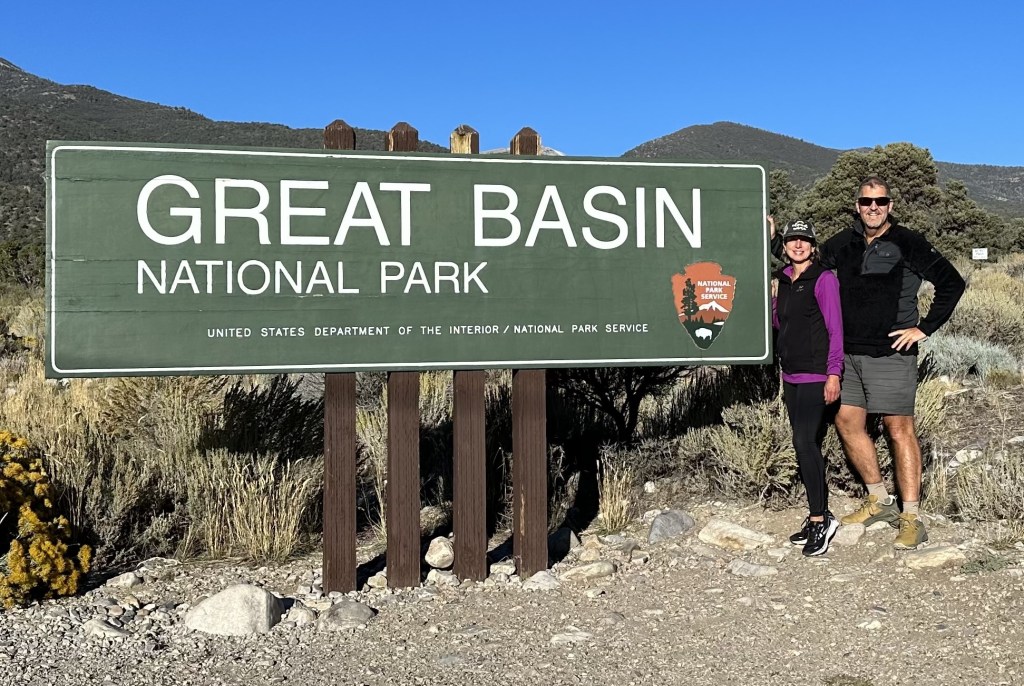
            I drive fast all the way across New York State.  We have a few close calls with the State Troopers and a couple of close encounters with the Mormons and Amish while picnicking in Palmyra, but with plenty of daylight to spare, we pass through Buffalo (and our cancelled hotel rooms) and arrive in Lewiston.  Our KOA Campground is just eight miles away from Niagara Falls.       The campground is packed solid with dozens and dozens of trailers, campers and motor homes and they seem to fill every available space.   It turns out that tent campers, like us, have their own segregated space on the other side of the creek which runs along a long row of blackberry bushes. We pull the car around to set up camp and find the tent area of the KOA to be deserted– we have it all to ourselves.  Unfortunately, we find that this seclusion can also mean mosquitoes and they are out in force.  Such a conniving man was he — that red-faced, chubby owner of the campground.  That devil acted so pleasant and spoke so devoid of warning while we checked in and signed the credit card receipt for a two nights stay.  After the business was done however, his big smile, half hidden under his bushy grey mustache, became sinister and he laughed a sneering laugh.   He could barely ask us through his chuckles if we had mosquito repellent.  We try to pitch the tent, but we find the bugs here so large and so aggressive that we are forced to take refuge in the car.    Even inside the car, they are all over us and we are swatting and killing mosquitoes right and left.  They are engorged with our blood and it splatters on the windows, the seats and the dashboard as we crush them.  A police detective would have opened this car up and started a homicide investigation on the spot.  We are forced to discard our grocery store repellent and purchase several cans of the expensive KOA Brand, super-duty, deluxe, all-powerful repellent with 40% DEET (normal is 10%) and now finally, fortunately, the bugs not only leave us alone…. They have left our camp area completely. 

            With a couple of hours of daylight remaining, we change plans and go out to Niagara to see the falls this evening.  It is a good choice.  We park the car on the American side and after a short walk we take in magnificent Niagara Falls.  Jen and the boys get to see them for the first time.  We walk everywhere, making an effort to get the best, or just different, vantage point.  We snap dozens of photos as the sun sets over the Canadian horizon to the west.  As the sky darkens, we take some time in the gift shop to buy some postcards and gather information about some of the adventures available to us tomorrow.  By now, the bright lights from the opposite side have come on, illuminating the falls in a rainbow of color.  The graceful, visual beauty and the loud roar of the crashing water makes for a strong, yet harmonious dichotomy.  We walk over two bridges to Goat Island and continue down some nature trails with scant lighting and find ourselves on the precipice of Bridal Vail Falls.  Although this massive fall accounts for only 1% of all the falling water here at Niagara, it is a rousing experience.  Staring down a 180 foot drop is intense, but the feeling of something moving right at your feet and being pulled off that drop… well, suddenly you feel like you are on unstable ground.  It is unsettling and I feel a rush of adrenaline and fear, very much like riding a rollercoaster.  This time, however, I am not moving at all.  We drive back to our camp in the dark, rush through the flocks of mosquitoes and dive into the tent. We all fall asleep quickly.

            We take in Niagara Falls again today: first stop Canada.  Slade and Gunnar have not set foot off of US soil before and they are very intrigued with the border crossings we must make going both directions.  The tough post-911 questioning and procedures are a bit strange for them and they insist that I seem really nervous when questioned…. But, I tell them simply that they have confused the difference of showing respect to the agents and nervousness.  On the Canadian side, you really do get the best overall view of Niagara Falls, but it is much more expensive and much more commercial.  Parking in the main lot in Canada is $20.00 and because of our modest budget, I almost don’t pay it.  On the US side parking is $8.00 dollars and is very much like a preserve– national park uniforms, signage and atmosphere dominate.  The Canadian side, however – wow, what a difference a bridge can make.  The physical area along the gorge and falls is pleasant, but the feel of the place and the people are very different, very European, very Quebec.  This side is dominated by French Canadians, their cars display license plates with the tag line under the numbers which reads: “Je me souviens” ( I remember ) essentially saying that even though we are ruled by Canada and are an English Colony; I remember that I am French.  This separate and superior attitude is stamped defiantly right on the plates by the local Quebec government.  Here at Niagara Falls these visitors are a rude irritation; pushing forward to the railings and unwilling to wait their turn.  They are obtuse; and they bombard our ears with loud honking to each other.  The boys keep looking at us with bugged eyes…. They are not sure what to make of these people.  They push us around like we are sparrows trapped in their gaggle of geese; and knowing we cannot understand them, they indiscreetly make us endure their boisterous language, which seems to be spoken through both nostrils.  We are a bit puzzled why all of them are only on the Canadian side, but soon find the neighborhood they came for just a block into the town.  Picture the Las Vegas strip crammed into the tiny cobblestone streets of a European village:  streets too narrow for cars to pass; giant neon signs even larger than the stores they advertise; T-shirt shops; souvenir stands; ticket booths; adult bookstores; liquor stores and hair salons.  Renee calls it “Moulin Rouge”.  To me, it is a cartoon nightmare…. a carnival funhouse gone mad.  We can’t wait to get out of there.

            After crossing back to the US side and paying for parking – again, we lunch right in the parking lot on peanut butter and jelly sandwiches.  This road-trip delicacy has become a staple for us; it’s cheap, it’s fast and it does not require refrigeration.   You can easily pick out the down-and-out travelers everywhere we go.  On long road trip vacations, the rich are savoring the food in restaurants like Skylon Revolution Niagara, Wolfgang Pucks’ Grand Café and the Casa Mia Ristorante.  Families like us, the poor or unemployed, dine on PB and J’s in the parking lot.  We often share a nod or a wave with another family when we spot them spreading peanut butter.  It’s a small sign of solidarity and understanding between our families.  PB and J sandwiches, we learn, are a great conversation starter too.  Many times the more outgoing half of a couple with kids will jokingly say… “Hey, that looks good. Do you have enough for us?”  Before long, you know where this family is from, what they are going to visit next and how long they have been out on the road.  You will often get some unsolicited recommendations in these conversations too. “Oh, you just have to go to China Doll Factory National Monument….. We spent half the day.” Or, “Make sure you stop at the Bittersville Zoo…. They have real zebras there!”   They usually end the conversation with “well, we are going to go have some lunch ourselves.  Nice talkin’ to ya.”  Across the lot we spy their trunk opening and out pops the paper plates and sandwich bread.

            The highlight of Niagara Falls comes after lunch on the Cave of the Winds tour.  We discuss the possibility of doing the Maid of the Mist boat tour instead, or doing both tours, but after seeing the boats make their runs, with hundreds of rain-coated guests standing toe to toe, shoulder to shoulder; we opted out.  The boys decided it was too much like being sardines in a can.  Cave of the Winds tour, of course, is the walking tour down to the wood decks at the base of the falls.  This is not just a sight and sound adventure — you really feel the force of the falls here.  On this tour you get wet.  As a teenager here many years ago, I shared this experience with two of my brothers on the family trip.  We were issued heavy-duty, rubber hooded raincoats and felt lined fireman’s boots. I recall getting a bit wet, but not soaked.  Apparently, the tour operators gave up on that five years ago and started issuing yellow plastic kitchen-trash-bag-like ponchos and disposable sandals. The poncho we place over our heads today looks like it could be torn from you in a stiff breeze.  The heavy mist falls all over us during the tour, but in the far left corner of the Hurricane deck, as it is called, you can stand right under the full force of the falls.  Only a fully mature, large bodied male like me, can stand in this spot without getting blown off of the platform; hence the name hurricane deck.  I stand in the falls, feet firmly placed, my body braced against the railing for security.  The hard falling water is cold and almost painful; but, the violent deluge is exhilarating on this hot, humid day and we take advantage of it.  We return cooled off and completely soaked.  Our yellow trash bag ponchos do absolutely nothing. 

            Later in the day, we make a tour of Niagara County.  We go north at first, past colonial Fort Niagara and then turn to the east and follow the shoreline of Lake Ontario.  Beautiful homes with large well manicured acres of grassy yards flank the water’s edge.  The view of the lake and their boat moored on their own private dock must be very satisfying, I think to myself.  The scene is grand, and we envy it.  “This is middle class Americana at its’ finest!” I exclaim. “Look at the life they have…. and it is so affordable.”  We confirm this by reading the details of a few “for sale” and “for rent” signs and the prices displayed along the way.  My mind begins to wander from the road.  I see myself here, amongst the lake, big yards, boats, private beaches, fruit trees and a luxuriously long driveway leading to my own three car garage.  I imagine my new home here without a single beat up car parked in front of my home for weeks at a time like we have back in Scranton.  I picture nice, trustworthy neighbors who will give a pleasant “hello” to me and my children without a foreign accent and a recently home-pricked tattoo displayed on their neck.  And then, I remember that winter brutalizes the folks here on the shores of Lake Ontario for… well…probably about nine months of the year.  My little daydream ends and the road ahead comes back into focus.  I take a deep breath as I adjust my position in the leather driver’s seat.  Vacation, I remember, is vacation, it is not reality.  We continue through Niagara County, carefully winding our way in and out of little one cop towns.  Each little village, almost all the same, with weary looking grocery stores and city parks with rusted out playground equipment and a single tennis court sporting a tattered net and long, robust weeds sprouting up through cracks in the concrete.  We are later stopped at a drawbridge over the Erie Canal – surprised it is still filled with water and that a boat is crossing under the bridge in front of us.  Learning about the Erie Canal growing up in school and later singing the songs about the barges and oxen and weary, sweaty men, you get the impression that it is now only a forgotten part of our history…. extinct, like the telegraph and the pony express. But, here it is, transporting tourists upstream.

            It is late afternoon and we have put off eating again for so long that we are now starving.  We pass by a few suspect eateries along the way and eventually spot a lonely lunch truck in a small parking lot.  We creep up slowly; not fully committed, but then shrug our shoulders and put the car’s transmission in park.  Jenifer and I choose a hamburger and hotdog to share, but the boys have their eyes on a hotdog variety called a “white hot”.   They are both very hungry and so they munch down the strange white wieners as they pull sour faces.  I taste what remains of Gunnar’s dog and find it disgusting as well.  I suspect strongly that it must be made of intestines. The worker reveals’ to us that her white hot dog consists of veal, pork, beef, hot spices, powdered milk and a bunch of other crap.   I want to ask her…“Hell, why not shove some Nestle Quick and jelly beans in there too,” but, I hold back.  The lunch truck worker apologetically vouched for the popularity of the white hot, so I figure it must be a local thing.  Evening approaches back at camp, so we swim in the pool, do some laundry.  Our secluded campsite is still ours and ours alone.  Nothing but green beauty and 15 other unused campsites surround us.  Our camp is impervious to bugs now that we are using 40% DEET and the mosquitoes are forced to sit off in the distance, sulking, waiting, for the arrival of additional tent campers.  None come.  It is the weekend now and the other side of the campground is full; packed side-by-side down motor home row.  RV’s and the folks inside are like aliens in their spaceships to me.  Some of these rigs are larger than our little post-war home back in Scranton.  Even a giant motor home is not enough sometimes.  Several of these rigs tow long, double-axel trailers loaded with tuff sheds, riding lawn mowers, gas barbeque grills and enough wood to build a log cabin.  “Nothing like enjoying the great outdoors to the drone of a generator and a blaring television set,” I tell my wife.   We cannot see these admirals of the great land yachts, but we hear them distantly through the trees and the thick brush which lines both sides of a gentle stream.  We share the campground only when we cross over a footbridge, down a small forested path to the KOA office.  We make dinner and enjoy the campfire in peace and tranquility.  The quiet moments we share as a family on this night, as we cook over the fire and eat our savory foil dinners feels so unusual to me.  These moments are so cherished and rare at home, but they have been commonplace on this trip. 

            In the morning we leave camp in the rain; packing as fast as we can in a downpour.  All the while we are excitedly shouting and laughing at each other.  Thunder and lightning rolled into the Niagara area last night and even though we were dry in the tent, the world around us, including the many items we left out on the picnic table are soaked.  We stuff the Grand Prix with all our belongings and head for the New York Thruway.   I proved to myself and to my family that we could take a road trip vacation even though we could not really afford to go.  My family got to experience something new about America and we bonded in some subtle and wonderful ways. On the way home we are already discussing where we are going next year.