Yellowstone National Park and a road trip through Montana.

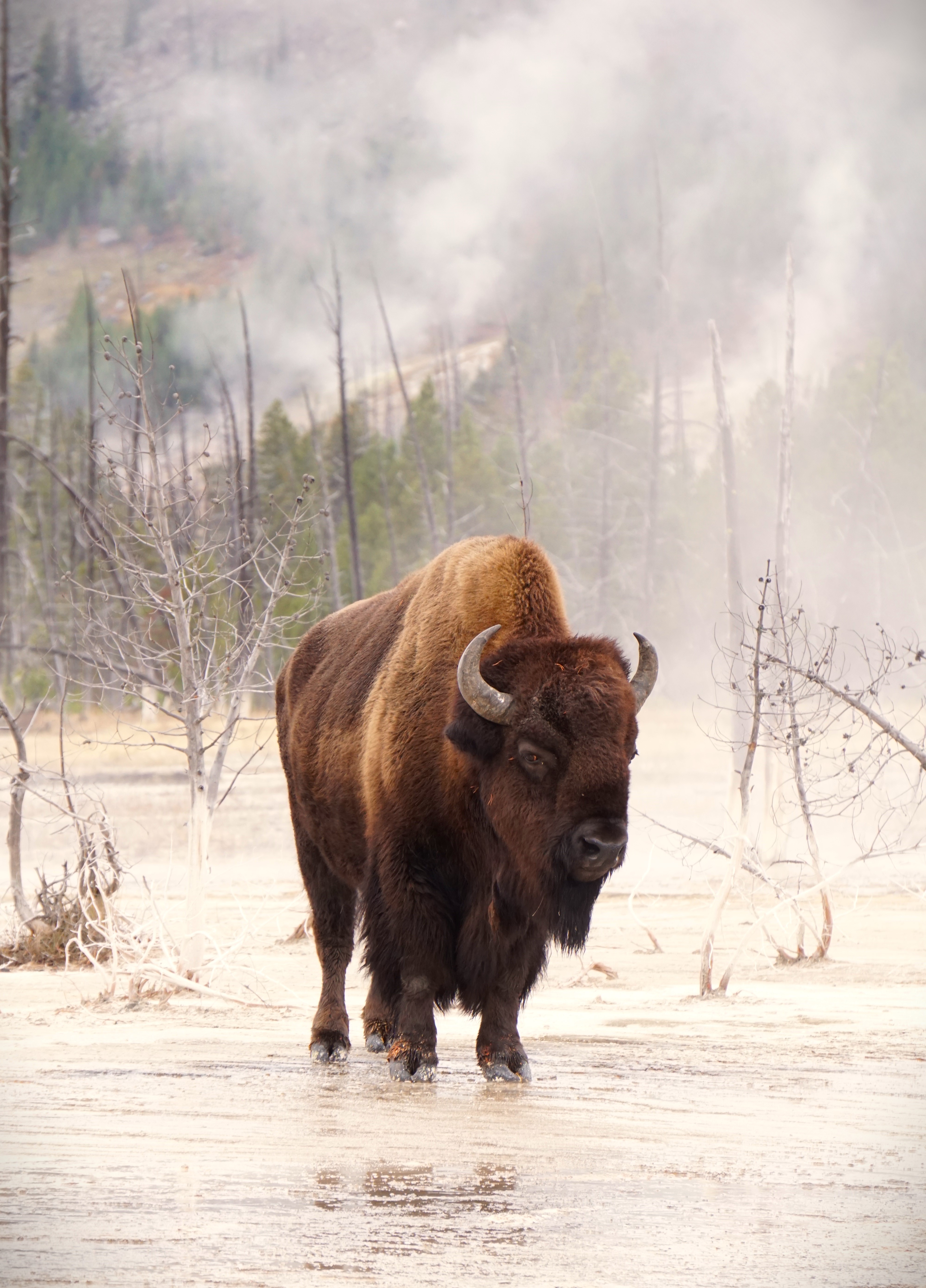
The most impressive animal in Yellowstone National Park is the Bison: also called a buffalo.

After a glorious three days and nights in Glacier National Park near the Canadian border it was necessary to travel the north-south length of the state of Montana to reach our next destination in Yellowstone National Park. Leaving Glacier, in a way, took a very long time, as the jewels of the park were visible in our rear view mirrors for a couple of hours. Eastward, out onto the yellow grassy horizon of Montana and highway 89 and then highway 2, provided a dramatic change of scenery. The Great Plains spread out before us like a golden carpet and the misty foggy skies ahead created an ethereal splendor. We passed through little towns like St. Mary, Kiowa, Browning, Meriwether, and Cut Bank. The tiny town of Meriwether obviously named after Meriwether Lewis of Lewis and Clark fame, who traveled nearby in their historic westward exploration of the newly purchased Louisiana Territory. Cut Bank, I remembered as the smallish municipality where Christopher McCandless worked for a summer at McDonalds, hiding out from his hideous parents, as portrayed in the Book and subsequent movie “Into the Wild.” McCandless eventually died in a deserted bus in the wilds of Alaska, starved to death, in an almost suicidal effort. It was a bit strange to pump gas into the van and shop in the Albertsons grocery store in the same complex as the very same McDonald’s where he worked.

The journey to Yellowstone National Park continued with brushes past Great Falls and Helena (the state capital) and other non-notable locations, but we found the town of Bozeman to our liking and checked into a Hotel for two nights to catch up on shopping and laundry. We even filled up the adventure van with gasoline again at the really cheap price of $3.49 a gallon (half of what the price was in California just before we left.)

Bozeman, Montana

The mountains around Bozeman, Montana.

Bozeman is a city located in the southwestern part of Montana, United States. It is the county seat of Gallatin County and has a population of 53,293 as of 2020. The city was founded on August 9, 1864, and named after John Bozeman, a pioneer and frontiersman from Pickens County, Georgia 1. The city is situated at an elevation of 4,817 feet (1,468 meters) above sea level. The city has a rich history and was primarily within the territory of the Crow people. For many years, indigenous people of the United States, including the Shoshone, Nez Perce, Blackfeet, Flathead, Crow Nation and Sioux traveled through the area, called the “Valley of the Flowers”.  In 1863, John Bozeman opened the Bozeman Trail, a new northern trail off the Oregon Trail leading to the mining town of Virginia City through the Gallatin Valley and the future location of the city. Bozeman has been one of Montana’s fastest-growing cities from 1990 into the new millennium. At the rate of three percent, Bozeman could surpass Great Falls as Montana’s third-largest city by 2025.  The city is known for its nearby recreation, scenery, and quality of life. When we arrived in Bozeman it was even a balmy 74 degrees and the colors on the mountains were in full form.

We were so impressed with the beauty, the people, the charming old ( but functioning ) downtown, the amazing place we ate for two consecutive nights called the Montana Ale Works, and just the general vibe we experienced. In fact, we put some thoughts to maybe moving here one day…. then the weather turned… and we remembered that there may also be some nasty and cold months here.

After checking in to the hotel, we made haste to an Indigenous People’s Day celebration in Bozeman.
Montana Ale Works was far more than beer. We experienced some of the best dishes anywhere. We ate here two nights in a row.
We even took the time in Bozeman to crash the headquarters of Oboz Footwear – makers of our favorite boots. I’m on my 11th pair.

South to Yellowstone National Park

Our original route to Yellowstone was leaving Bozeman on Interstate 90 to Highway 89, where we could enter through the North Gate and see the Albright visitor’s center. Heavy snow began to fall outside of Bozeman and we redirected to a safer weather route and went to the West Yellowstone entrance instead. We checked in to Madison Campground for two nights. It would be the last few days anyone would be here, as all the Campgrounds would be closing for the winter. The ranger joked with us that the “place is shutting down, We close the campgrounds, lodges, roads… turn off the geysers and lock up all the animals.” We soon realized that we were getting our visits in just before the lid was closed up on both Glacier National Park and Yellowstone National Park.

Glacier National Park

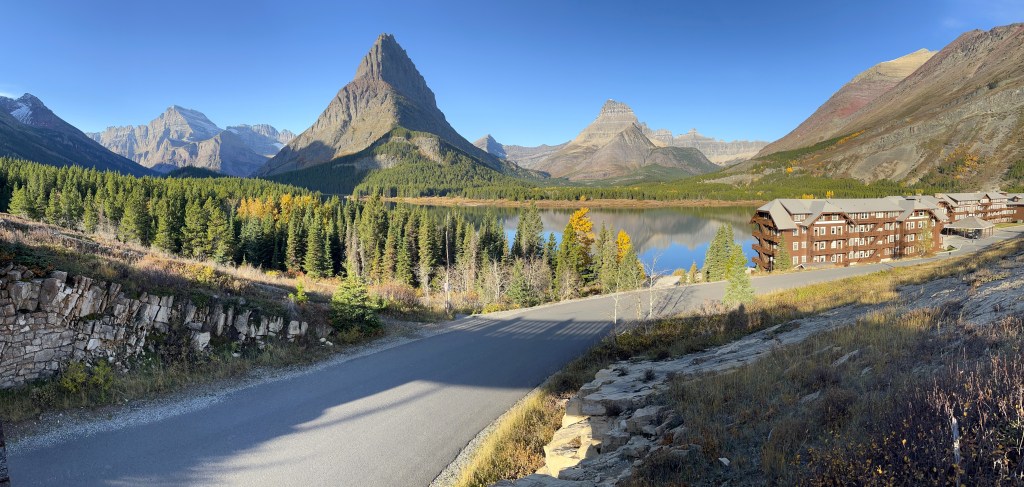
Glacier National Park is nothing less than magical. The view behind Many Glacier Lodge.

Our boondocking spot just outside Glacier National Park was safe and quiet and extremely cold. After coffee in the van, I opened the sliding door to a slap-in-the-face 31 degrees F. We quickly made the decision to get dressed, drive to Apgar Visitor’s Center, park in the lot and make breakfast there. It was a good idea, as we had a flat surface to make food and a set of warm bathrooms with flush toilets which were open even though the Visitor’s Center was not.

Glacier National Park is a national park located in the northwest corner of Montana along the spine of the Rocky Mountains, adjacent to Waterton Lakes National Park in Canada. The park encompasses more than 1 million acres and includes parts of two mountain ranges, more than 130 named lakes, more than 1,000 different species of plants, and hundreds of species of animals. The park is known for its seemingly endless acres of rugged and breathtaking landscapes. With over 700 miles of trails, Glacier is a paradise for adventurous visitors seeking wilderness steeped in human history.

The Road to the Sun

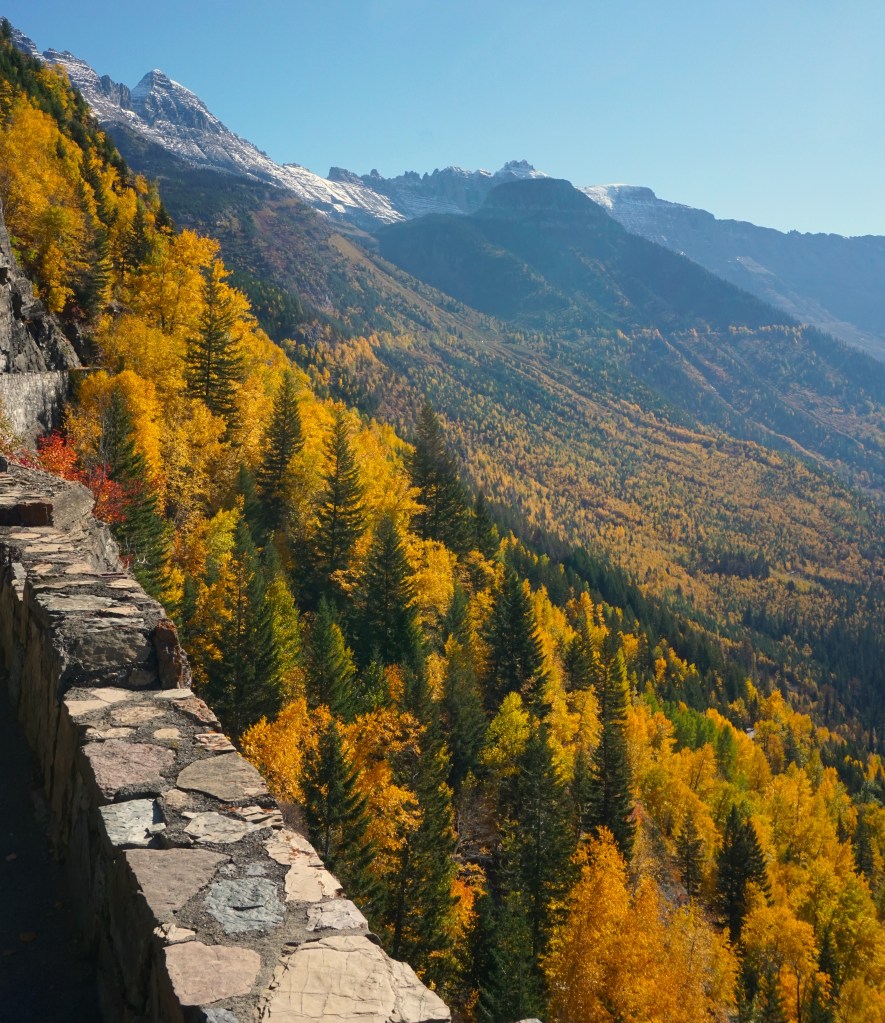
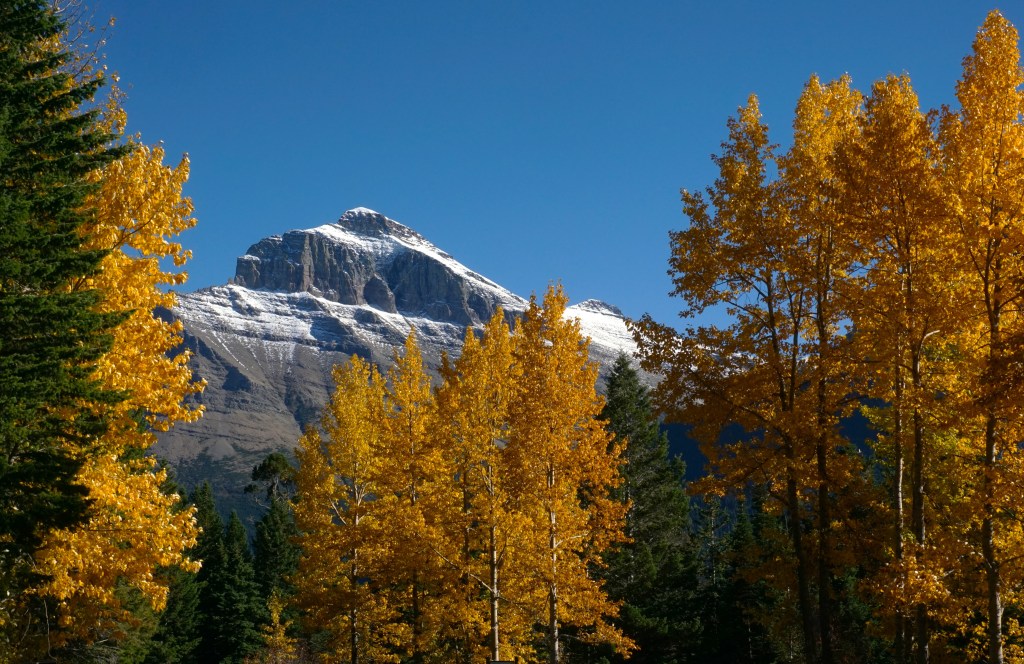
Fall colors and a fresh dusting of snow made the Road to the Sun drive even more amazing this time of year.

Going-to-the-Sun Road is a scenic mountain road in Glacier National Park. We had been looking forward to this drive for a long time, but we were worried that it would be closed by the time we arrived at the park. The Going-to-the-Sun Road has a hard closure date of October 15 this year, but it can be closed earlier if winter arrives. We are in luck with a beautiful weather window. Although it was freezing cold in the morning, the day warms into the 60’s and 70’s later in the afternoon. Going to the Sun is the only road that traverses the park and crosses the Continental Divide at Logan Pass, which is the highest point on the road at 6,640 feet or 2,025 meters in elevation.

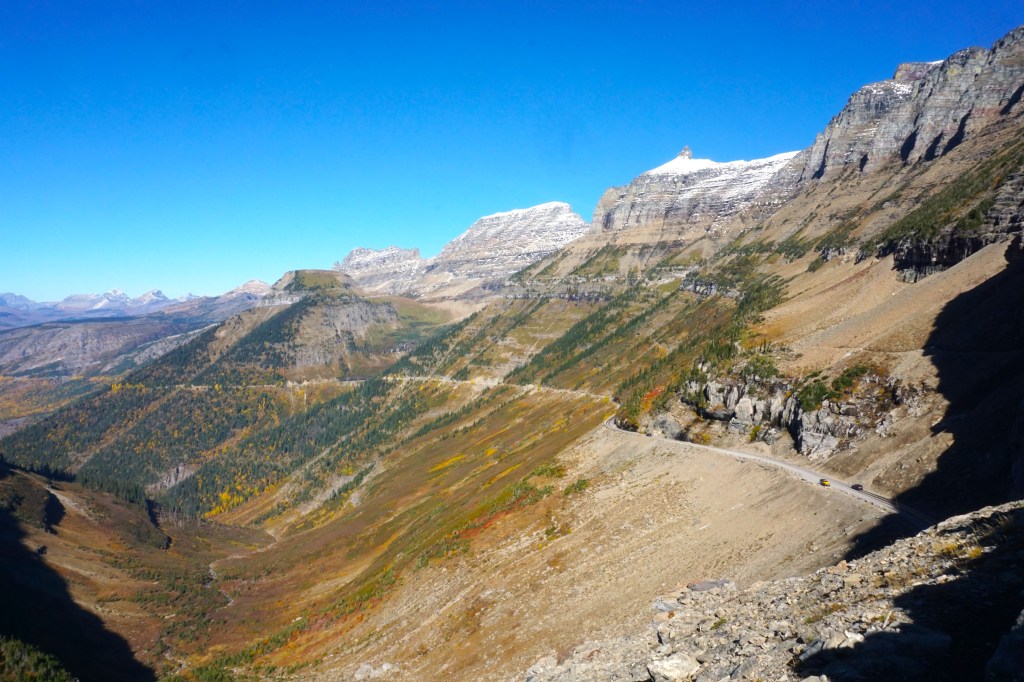
The Going-to-the-Sun Road is one of the most iconic roads in North America. We were lucky to make the drive before it closed for winter.

The road spans 50 miles (80 kilometers) and offers views of glaciers, valleys, waterfalls, mountains, and in the Summer months, wildflowers. We have learned that construction of the road began in 1921 and was completed in 1932. The road is named after Going-to-the-Sun Mountain which dominates the eastbound view beyond Logan Pass. One Native American legend concerns the deity Sour Spirit who came down from the sun to teach the Blackfeet the basics of hunting. While returning to the sun, an image of Sour Spirit was placed on the mountain as an inspiration for the Blackfeet. Another story has suggested that a late-19th-century Euro-American explorer provided the mountain’s name and the legend. Either way, we found the road to be a can’t miss adventure in Glacier National Park.

The road is notable as one of the first National Park Service projects specifically intended to accommodate automobile-borne tourists. It is both the only link between the east and west sides of Glacier National Park and the only extensive automobile route in the park. The road defines Glacier’s basic circulation pattern and receives heavy amounts of traffic during summer months. Although we did not face too much traffic in the month of October, it was still a scary and exposed drive for those who have a fear of heights.

Hiking Trails in Glacier National Park

CT finds the going easy on the Avalanche Lake Trail in Glacier National Park

We made use of many little trails campground tours while walking Jessi, our Lab Shorthair mix adventure dog, but our four main hikes during our time in Glacier were Avalanche Lake, Highline Trail, Hidden Lake Overlooks and Grinnell Glacier Trail.

Avalanche Lake was fogged in when we arrived at its shore.

Avalanche Lake trail is about 4.5 miles long and has an elevation gain of 741 feet. The trail begins at the Avalanche Lake Trail Head which is a large parking lot just past the nine-mile point on Going-to-the-Sun Road. Early on, there is a fast flowing creek which has carved beautiful, flowing paths into the reddish-brown argillite and quartzite rock that was compressed under sea water and exposed to oxidation. We had the trail to ourselves at first, but soon we had to share the trail on the way down with what seemed like busloads of tourist. This is a common issue with the easy, but beautiful trails we hike.

A view of Going-to-the-Sun Road from Highline Trail.

Later in the day, when we reached Logan Pass, we found a parking spot and did a partial trek on The Highline Trail and the full length of the Hidden Lake Overlook Trail.

The views on the Hidden Lake Trail were worth the effort.

Both of these were spectacular and highly recommended. The highlight hike of our three day stay in Glacier National Park however, was the Grinnell Glacier Viewpoint Trail.

CT at the one-mile mark of our trek to Grinnell Glacier, found high in the cliffs in the background.

After our drive over the Continental Divide and over to the East side of the park, we were able to secure a campsite in Many Glacier Campground for just $10 per night. As the camp was basically shut down for winter – with no services, or water or open bathrooms… it was highly discounted. After a relaxing morning and a hearty breakfast, we set out to make it to the end. The trail would be 12 miles from our campsite and a steep, lose, and often cliff-side 2,600 feet of elevation gain on the way up. This is the kind of trail which is far less populated with casual tourists.

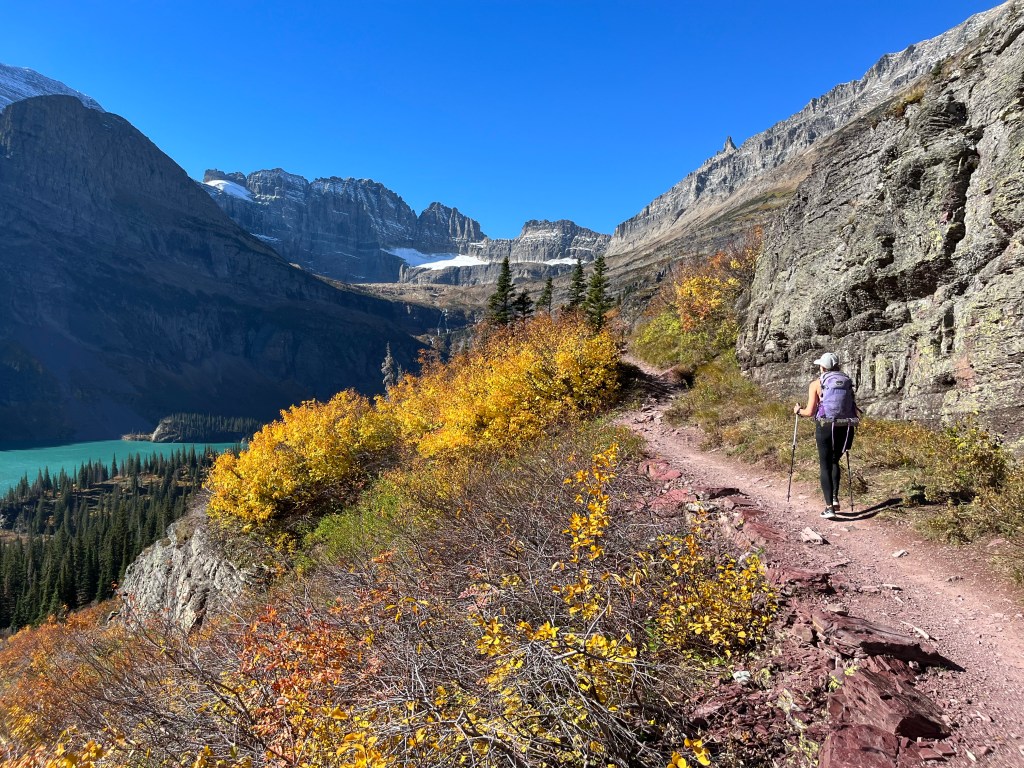
It is only mile two but, it is already heating up. We shed some clothes and trek on. Some of the glaciers and snowfields can be seen in the cliffs above.

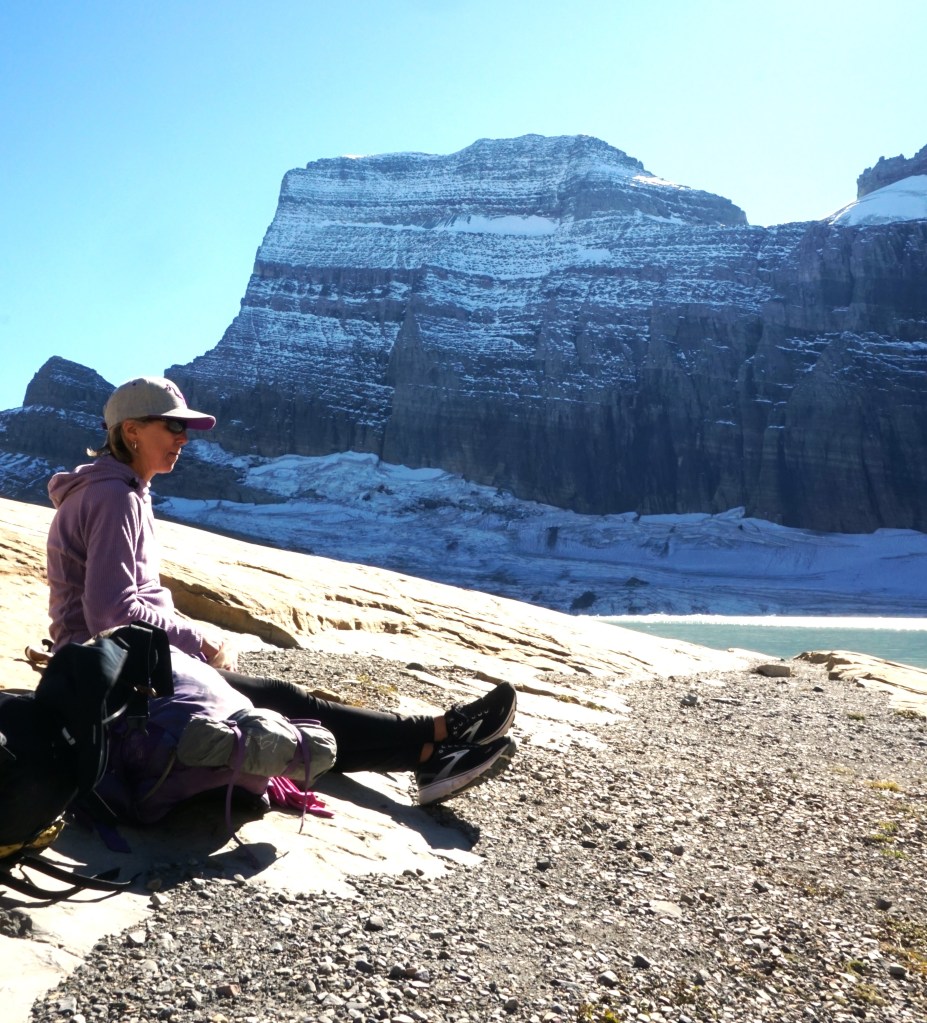
The glacier-fed lakes and the red and yellow fall colors are magical and as the air thins out and the climb gets steeper, our spirits are lifted by the sheer radiance of the scene. After more than three hours of climbing, we reach Grinnell Glacier and the grey, silt-filled lake which floats its calved icebergs. We are tired, but we lay out on the hard rock surface like it is a king-size bed and rest. The sun is hot and the wind is cold here. We are troubled about what to wear, as we are both feeling sunbaked and frozen at the same time.

Fire and Ice. On the shores of Grinnell Lake
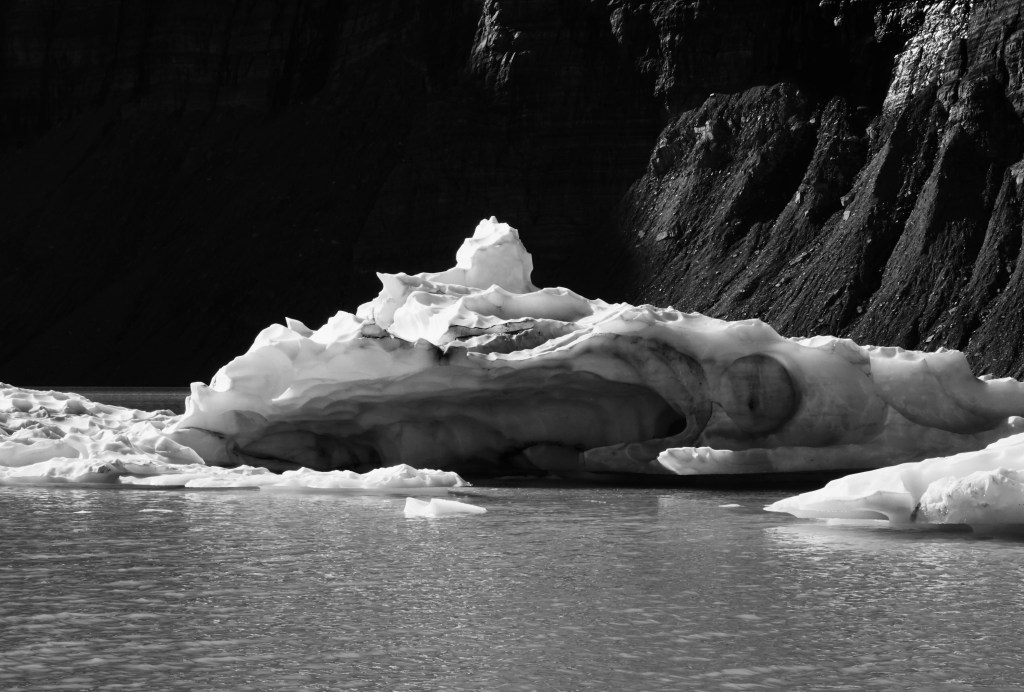
Grinnell Lake, a calved iceberg and the dark cliff behind in Black and White.

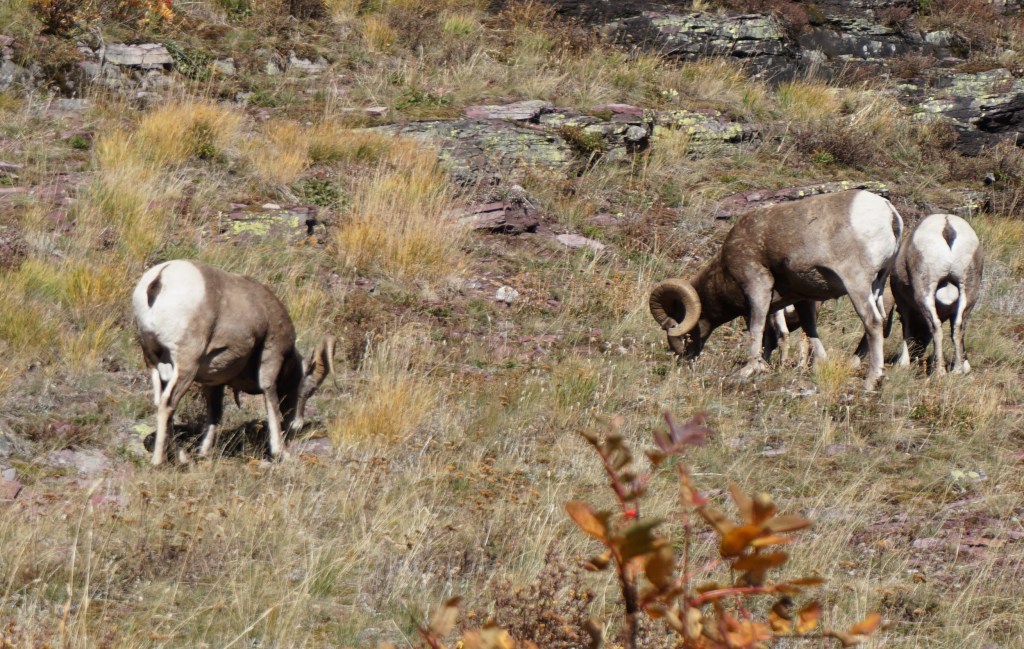
We munch on energy bars, an apple and electrolyte infused drinks for lunch and then gear up to make the six-mile downward trek to camp. Just when the pain begins to set in deeply and for a few days to come… we run into some big horn sheep and take a long break to enjoy their beauty and chuckle at their indifference to us.

Big Horn sheep above the Grinnell Glacier Trail.
The views from Grinnell Glacier Trail in Glacier National Park are amazing

The last mile of the hike is painful for me. I seem to be hurting from every joint and muscle. It is a struggle to make it back to camp. CT encourages me well and I trudge on. Back at camp we set a big fire and enjoy a delicious meal and a good bottle of wine as the sun sets behind the mountain. The golden leaves of the aspens which surround our camp have fallen on our site all day and leave a thick bed of color coating our van and picnic table. It is gorgeous. It is our last night in Glacier National Park. We are glad we came.

Great Basin National Park

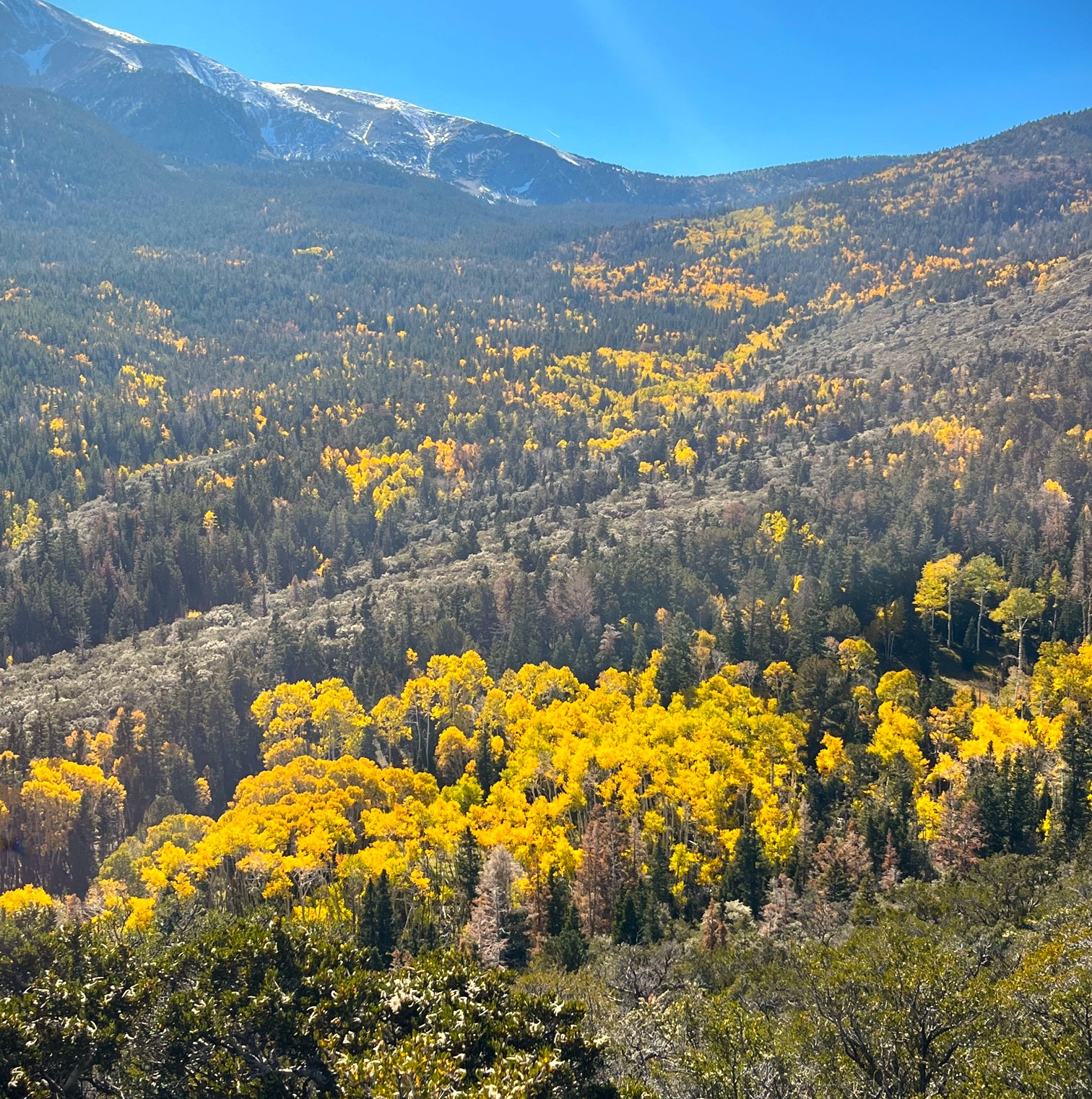
Wheeler Peak in Great Basin National Park through the fall colors.

Great Basin National Park: A Hidden Gem in Nevada

Great Basin National Park is one of the lesser-known national parks in the United States, but it offers a variety of natural and cultural attractions for visitors like us. Located in east-central Nevada, near the Utah border, the park covers 77,180 acres of land that showcases the diversity of the Great Basin region, The drive to get to the park is not easy and covers hundreds of miles over empty and desolate ground covered with sage brush and dry earth. We started north from St. George on I-15 Freeway before changing to Highway 21, passing through the towns of Milford and Garrison, where we could see historic buildings and old mines. As you cross the border into Nevada, we entered the Great Basin, a vast region of mountains and valleys that covers most of the state. You will arrive at Baker, The trip is about 220 miles long and takes about four hours to drive.

We drove by two of these signs of different roads along the way to and from Great Basin National Park

The park is named after the Great Basin, which is the largest area of contiguous endorheic watersheds in North America. The region is bounded by the Wasatch Mountains to the east, the Sierra Nevada to the west, and the Snake River Plain to the north. The south rim is less distinct. The Great Basin includes most of Nevada, half of Utah, and sections of Idaho, Wyoming, Oregon, and California.

Bristlecone Pines

Perhaps my favorite park of our evening hike was finding the rare Bristlecone Pines. Great Basin National Park features a range of ecosystems and habitats, from sagebrush-covered foothills to alpine meadows and peaks. The park is home to 11 species of conifer trees and over 800 species of plants, some of which are endemic to the area. One of the most remarkable plants in the park is the Great Basin bristlecone pine, which is the oldest known living non-clonal organism in the world. Some of these ancient trees are over 5,000 years old and grow at the tree line near Wheeler Peak, the highest point in the park at 13,063 feet.

This Bristlecone Pine is 3,200 years old and is still producing live branches. We arrived at the grove just before dark.

Hiking in Great Basin National Park

CT treks along Stella Lake in Great Basin National Park

We took the opportunity to complete on long hike in the evening just after setting up camp in the Upper Lehman Creek Campground. We wanted to stay at the Wheeler Campsites at 10,000 feet elevation, but they were closed just before our arrival. Our hike started at the wheeler Peak trailhead and took us by two alpine lakes and the Bristlecone Pines. It was about six miles and took a bit longer than two hours. All of the hike was at an altitude we had not been in a while, so it was a great workout.

Doing my best to keep up at over 10,000 feet in Great Basin National Park

Great Basin National Park is a hidden gem in Nevada that deserves more attention and appreciation from travelers who are looking for a unique and diverse experience in nature. The park offers something for everyone, whether it is hiking, caving, stargazing, or simply enjoying the solitude and beauty of the wilderness.

Camping and Stargazing

We woke early, made coffee and a roaring fire while the stars were still brilliant in the night sky.

Great Basin National Park also boasts some of the darkest night skies in the contiguous United States, making it an ideal destination for stargazing and astronomy enthusiasts. The park offers free ranger-led astronomy programs every Wednesday, Thursday, and Saturday from May through September. Visitors can also enjoy viewing the annular eclipse that will occur on October 14, 2023 at Great Basin National Park. We did not have time for a ranger lead program, but we did see some of the brightest stars we have ever seen.

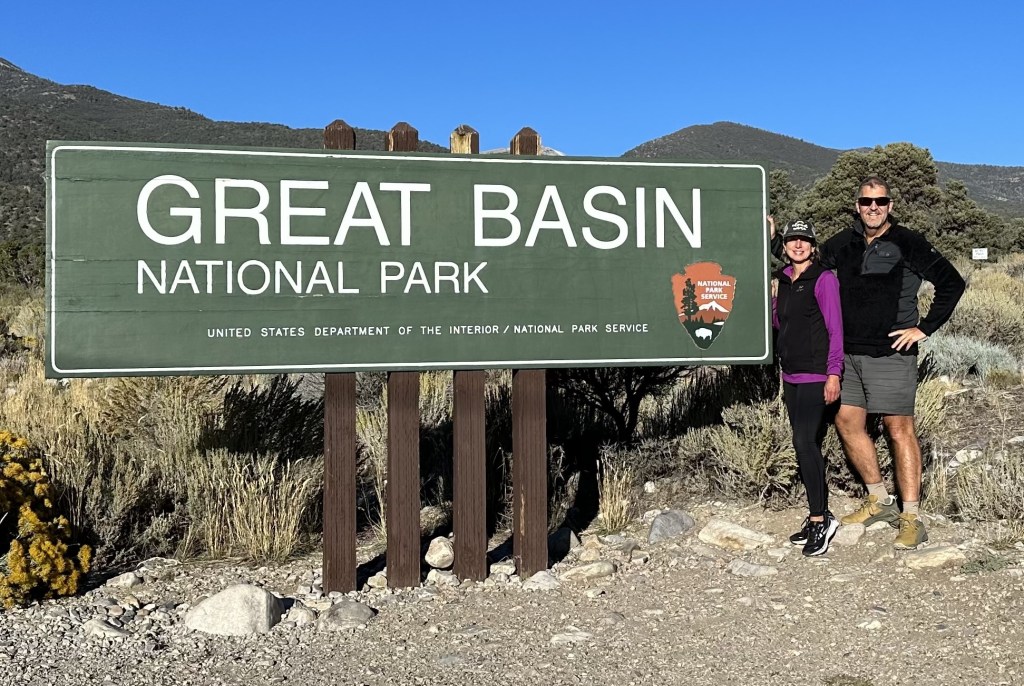
On our way out of the park we stopped to take in the unique entrance sign at Great Basin National Park.

After an evening of hiking, a night and early morning campfire and stargazing, we made an early start for the 450 mile drive to Idaho Falls, Idaho. The day was filled with a scenic road trip that took us through some of the most diverse and beautiful landscapes in the western United States. We hoped to stop in Twin Falls, Idaho and see the “Niagara of the West” Shoshone Falls, but the road was closed for repairs and we were turned away with just a mile to go. Not everything on this long road trip will be perfect, but we are creating perfect opportunities at least.

Follow / subscribe to this blog and follow us on our journey across the United States.

The Lost Coast Trail

By Keith Alan Robinson

Sometimes you just have to go!  When the opportunity to backpack into a rugged and isolated black-sand coastline comes along – the call of the wild is, for some, too hard to resist.  This was definitely the case for our group of six adventurers back in June of this year. RMV’s Cynthia Tessin, Sam Couch, Paul Johnson and Jim Valentine, along with friends Keith and Tim, planned and executed a four-day, three-night sleep-on-the-beach excursion which has been placed on a world list as “one of the fifty places you must hike before you die.”

This dramatic 68,000-acre conservation area, 200 miles north of San Francisco, is part of California’s ‘Lost Coast’.  This 35-mile stretch, where land and sea converge, is a spectacular blend of primeval mountains and unspoiled seashore – almost untouched by civilization.  Known for its diverse geography and ecosystems, this breathtaking coastline is one of the longest stretches of pristine beach anywhere along the Pacific. 

The trail is mostly not a trail at all, but is in fact, more of a trek along the water’s edge in wet sand, rocks, and boulders.  However, a significant portion does divert into forest, grassland, and meadow above the rocky cliffs.                               

Day 1

The first day begins at the village of Shelter Cove.  The six of us load into a hired van with a very experienced local who takes us on a two-hour drive through the King Range of coastal mountains.  The destination is Mattole Beach.  We wave goodbye to the shuttle driver, heft our loaded packs onto our backs and set off into the windy morning.  None of us would see another car or truck for nearly four days. At Mattole Beach, a sign at the trailhead reads: “Allow at least three days to backpack the wilderness coastline. Hardy hikers are rewarded with solitude and ever-changing vistas.”  This sign is more than true, as the views are always changing and fellow hikers are encountered very rarely.

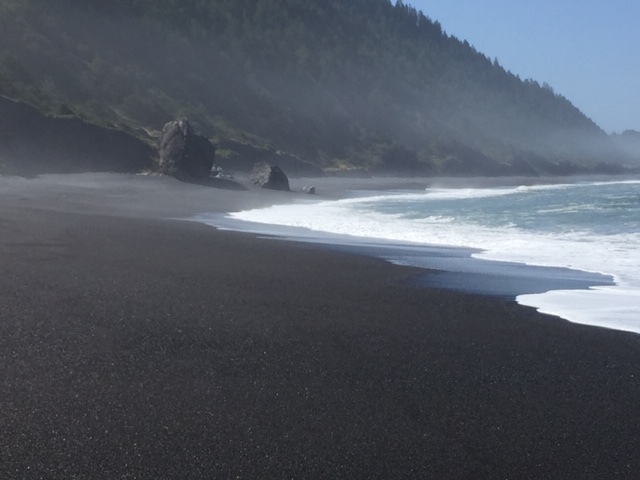
After negotiating a series of dunes, we are greeted by sun bathing sea lions and an endless blue-green water.  We are stunned by the grand expanse of wild beach, the Hawaii-like black sand, and the realization for some of us that this once-in-a-lifetime hike is finally underway.  Later, in the noon-day sun, we navigate along the trail as it winds its way high above the sea.  We skirt poison oak, skip over small streams and climb up cliffs, where we can finally see the 100-year-old Punta Gorda Lighthouse – our perfectly timed break for lunch.  The building has stopped being lit up to warn ships many decades ago, but it still serves as a beacon for Lost Coast hikers.  Relieved from our heavy packs and with our weary backs propped against the white walls of the tower, we eat and watch the seals play in the surf below.

Our original plan for day one is to hike about five miles to the start of the first impassable zone. However, it is still early afternoon and high tide is more than an hour away, so we start out. There are several parts of the trail that go underwater at high tide, so a tide chart is essential to traverse through these zones. Our permit instructions include a warning that people have died after getting caught in the rocks and surf. So, we hustle along as we are not sure about the conditions.   As we near our newly projected campsite, some 2.5 miles into the impassable zone, the tide is beginning to reach the cliff side and our hustling soon becomes a series of desperately timed dashes over rocky terrain and the surges of high tide.

We settle in a remote canyon along Cooskie Creek and pitch our tents a few hundred feet from the ocean.  We have the camp to ourselves – except for a few deer. As soon becomes the norm, every evening we gravitate to the water’s edge and watch the sunset before heading back to the campfire. On this first night, we learn that Cynthia and Keith have packed in a special surprise to celebrate Sam’s birthday – two bottles of wine and the ingredients to make s’mores! What a treat!  Later, sleeping is not difficult as the rumbling waves and the din of a babbling brook soothes our slumber.

Day 2

Low tide this week is during the mid to late mornings. Since we are already half-way through the first impassable zone, we only have two more miles until we are in the clear for the day.  After coffee, breakfast and a morning campfire we set out for what will be our longest day. We alternate between travelling as a group or in pairs.  Jim always wants to get a little head start in the morning as this is his first backpacking trip.  He claims to be slow, but actually hikes like a champ.  He is so methodical that he earns the trail name ‘Metronome’.    By 10 am we are at the end of the first impassable zone. We all take a break, enjoy a drink out of Randall Creek, refill our water bottles, and take in the scenery.   Only 10 more miles to go to get to our next camp at Big Flat.

Our second day changes with each mile and we experience a variety of conditions. The morning starts out calm and cool. After our first break, the cold blast of wind picks up considerably and although it is at our backs, at times it pushes us along whether we like it or not.  It is tricky crossing creeks, balancing yourself on a log bridge only to have the wind catch your backpack and almost toss you in the creek. Footing conditions change quite a bite on this stretch too – from sand, to sand and rocks, to bouldering, and to hard pack trails. In the late morning we have discovered a stash of huge whale bones, the only remnant of a beached giant on this lonely coast.  Each of its vertebrae are larger than basketballs and we can only imagine the scale of the entire animal.  By afternoon, we have an unending, strong, cold wind coming in from the sea and our only relief is found in a creek canyon or very large rock.

In addition to the wind, we are struggling to walk mile after mile hauling heavy packs in sand.  Our feet sink and slide with each stride. Sometimes we can walk in each other’s footprints to make it a bit easier. Other times we seek out rocks that are flat and provide some traction. When we are on a hard trail, we feel like superman!

By late afternoon we find ourselves on a grassy plateau. This turns out to be the beginning of Big Flat, an area which is the drainage from Kings Peak, a mountain Cynthia, Sam, Keith and Tim hiked earlier in the week, and the highest point in Humboldt County at 4,088 feet.  We find a flat and windless place to set up camp along the creek.  After dinner, we stand on the beach again and look west as the sun sets below the horizon.  After about a 11 ½-mile day, we are beat and ready to sleep.  Before climbing into our tents however, we enjoy the last of the fire as it dies down and we look in the direction of the trail, where we see the distant shimmering lights of Shelter Cove – our goal in two days.

Day 3

We wake to another gorgeous sunrise.  The air is cool and the sky is misty, but we are warm around our campfire as we laugh together and share stories from the trail over coffee and breakfast. By now, the routine of breaking down camp and repacking our gear is streamlined.  Paul and Jim get away quickly.  Keith and Cynthia are close behind and Sam and Tim are not rushed.  Many of us regard this day’s hike to be the most scenic part of the trail.  The sand is cleaner, darker, the mountains greener, and steeper.  A graveyard of gigantic bleached-out redwood trees washed out to sea in flash floods, have been returned to the beach as barge-like driftwood during high tide or big surf, and now remain in place as a memorial to their greatness. The fog this morning floats in and among the hills and beach in a mystical, other worldly setting.  Last evening’s high tide has smoothed out the beach from the water’s edge to the base of the mountains.  There is not a footprint in the sand for miles.  We feel like we are alone in the world. 

After a mile or so, Keith and Cynthia turn up the heat and power-hike to secure the next campsite by lunchtime.  They eat, go for a swim, fly their yellow kite and get sunbaked in the now clear and torrid blue sky.  Sam is a loyal friend and slows his pace keeping company with Tim as he struggles with an injured knee.  Parts of the trail, over the last 20 miles, have been very challenging and we are grateful there have not been more injuries.  At this camp we pitch our tents about 100 feet from the rolling surf and then spend the afternoon relaxing on the sand and wading in the water.  This beach has no parking lots, no lifeguards, no rules, no signs, no trash, no people.  In fact, this beach is ours.  Our time here is spent like we have travelled to a different time.  A time and place unchanged for millennia.

Our campfire, dinner time, and evening comradery is felt more deeply as we know this is our last night in this land of the Lost Coast.  There is a bond which forms in the sharing of struggle, the primacy of privation, and the enjoinment of joy.  The six of us feel this bond tonight, the way we all feel the soreness in our muscles, the need for a shower, and the longing for a cold beer.  We sleep like babies.

Day 4

Morning brings the awareness that everything is wet. The night’s coastal humidity and dense fog have soaked everything completely.  As the sun rises over the King Range the towering pine trees split the sun’s rays into streaks of focused light the way a spot shines down upon the actor on a stage.  The black sand is lit up by these streaks of light and we move out tents, sleeping bags and wet clothes to these areas to dry.   Soon a thick, smoke-like steam rises from our gear as though it will combust at any moment.  As it dries, we eat our final meal on the trail.  Our bear canisters are now empty of food and we stuff whatever we can in them to create room in our packs.  The bear proof containers are a requirement and a necessity as the beaches can be visited by the local omnivores in search of an easy hiker-provided meal.  We did not see any bears or bear tracks.  To some of us, this is a good thing.  To others of us, it is a missed opportunity.

Our final miles are difficult.  We are tired and the rest of the route is nothing but soft, hot, black sand.  We trudge along as our ending in Shelter Cove grows nearer.  We spread out over the last few miles, but cheer each other on as each of us goes up the steep incline and crosses the finish line into the parking lot.  At trails end we celebrate and begin conversation about lunch in town.

The beauty of this rare expedition is one that should be enjoyed by anyone who loves adventure and solitude.  For the six hikers on this trip who do enjoy those things, we have a new story to tell, a new voyage to expand our experiences, and a big wilderness check mark to clear our bucket-list. When it comes to The Lost Coast Trail… Sometimes you just have to go.